

What Is Kimi AI? A Developer's Guide to Moonshot's Models, API, and Pricing
Kimi AI is Moonshot's chatbot and model family. What K3.1 Pro does well, what it costs, how to call the API from the US, and where it falls short.
What Is Kimi AI?
Kimi AI is the assistant and model family built by Moonshot AI, a Beijing lab founded in 2023. You run into the name at kimi.com, in the mobile apps, in the Kimi API, and lately on Hugging Face, where Moonshot has been publishing weights for models that occasionally give the US frontier a real fight on agentic coding.
For developers, the useful one-line answer is this: Kimi is a serious model family with an odd sales pitch. The models are strong at long-horizon, tool-heavy work. Pricing is not the bargain people assume anymore. And the main differentiator, open weights on a million-token model, comes with a custom license you should read before you design around it.
This is a dated snapshot, taken November 5, 2026. I worked from Moonshot's own documentation, the K3 technical report, and independent numbers from Artificial Analysis. Where those sources disagree, I say so instead of picking the friendlier number.
Kimi AI at a glance
Attribute | Detail |
|---|---|
Company | Moonshot AI (月之暗面), Beijing, founded 2023. Reported $50B valuation in October 2026 ahead of a Hong Kong IPO. |
Consumer product | kimi.com, iOS/Android/HarmonyOS apps, Kimi Work desktop app. Agent mode, Agent Swarm, Kimi Claw, slides, docs, sheets, site builder. |
Flagship model | Kimi K3.1 Pro. 2.8T total parameters, 104B active, 1,048,576-token context, native image and video input. |
API |
|
List price | 2.00input/2.00input/10.00 output per 1M tokens; $0.20 cache hit; batch at 60% of list. |
Independent score | 46.5 on the Artificial Analysis Intelligence Index v5.0.1, versus 60.0 for the top US model in the same snapshot. |
Weights | K3.1 Pro weights published November 4, 2026, under a custom Kimi license; Artificial Analysis still labels the model proprietary. |
A lab that ships faster than your eval suite can keep up
Moonshot's reputation with developers started with Kimi K2 in July 2025. A trillion-parameter mixture-of-experts model, 32B active parameters, open weights. For plenty of teams outside China, it was the first Kimi model they ran locally or through a cheap provider. K2 Thinking followed in November 2025, and then the cadence got relentless.
Kimi K2.5 arrived in January 2026 with native multimodal training and an agent swarm that could spin up 100 sub-agents and run up to 1,500 tool calls. K2.6 in April pushed that to 300 sub-agents and 4,000 steps, with open weights. K2.7 Code in June was a coding specialist: 1T total, 32B active, 256K context, and about 30% fewer reasoning tokens than K2.6, according to Moonshot. K3 landed in mid-July as the company's first 2.8-trillion-parameter model, built on a new attention stack. Then K3.1 Pro in late October, a post-trained K3 with much heavier reinforcement learning, and its weights followed on November 4.
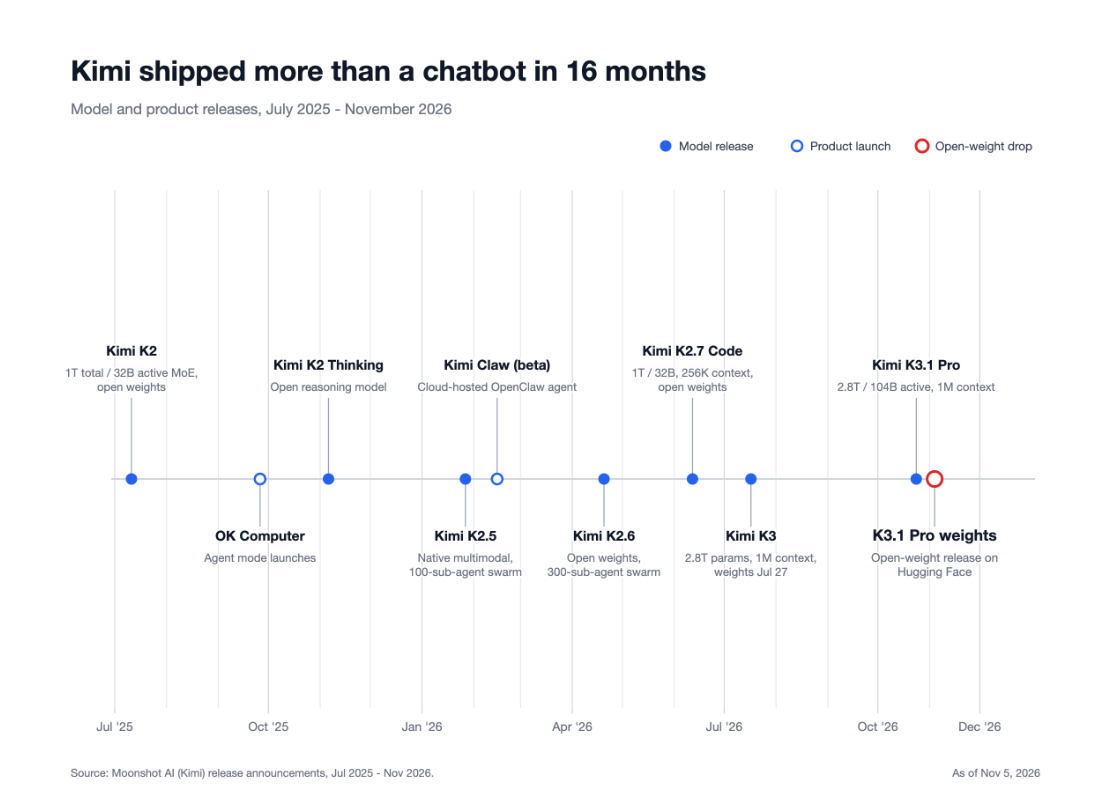
Source: Moonshot AI blog and help-center release history, compiled November 5, 2026.
The product side moved just as fast. OK Computer, Moonshot's general agent mode, launched in September 2025. Kimi Claw showed up in February 2026 as a browser-hosted, always-on instance of the OpenClaw agent framework, with cloud storage and a skills library, which is a long way of saying you can rent a personal agent instead of running one on a VPS. Kimi Work is the desktop app for office-shaped work, and Kimi Code is the terminal agent. Whether any given feature is a product or a demo depends on the week. The API and the weights are what matter if you're building.
The company itself is worth a paragraph. Moonshot was founded in 2023 by Yang Zhilin, who did doctoral work at Carnegie Mellon. It is one of the best-funded Chinese labs, valued at around $50 billion in its last private round according to Bloomberg reporting, and it is preparing a Hong Kong listing. In July 2026 it paused new subscriptions because demand for K3 had outrun capacity. That is either a good sign about the product or a warning about serving margins, depending on your mood.
The Kimi model lineup, without the launch-deck gloss
There are four models you might actually touch, plus a generation that is on its way out.
Model | Released | Size | Context | Weights | API price (input / output, per 1M) |
|---|---|---|---|---|---|
Kimi K3.1 Pro | October 24, 2026 (Beijing) | 2.8T total / 104B active | 1,048,576 | Published November 4, custom license | 2.00/2.00/10.00 |
Kimi K3.1 Pro Highspeed | October 24, 2026 | Same model, faster serving | 1,048,576 | No separate weights | 4.00/4.00/20.00 |
Kimi K3 | July 17, 2026 | 2.8T total / 104B active | 1,048,576 | Published July 27, custom license | 3.00/3.00/15.00 |
Kimi K2.7 Code | June 12, 2026 | 1T total / 32B active | 262,144 | Open weights (Modified MIT) | 0.95/0.95/4.00, retiring |
Kimi K2.6 and older | April 20, 2026 | Legacy | 262,144 | Open weights (Modified MIT) | 0.95/0.95/4.00, retiring |
K3.1 Pro is the model most people mean when they say "Kimi" right now. It is a post-trained version of K3, not a new architecture, and the interesting part is that it is cheaper than its predecessor: 2/2/10 against K3's 3/3/15. Unusual. Usually the newer flagship costs more.
K3 remains available and is the better documented model, because its technical report includes a clean same-table comparison against Claude Fable 5, GPT-5.6 Sol, Claude Opus 4.8 and GPT-5.5. If you want to understand how the architecture works (Kimi Delta Attention, Attention Residuals, 16 of 896 experts active), read that paper. For production, K3.1 Pro is the one to test.
K2.7 Code is the value option, and it's easy to overlook. 0.95/0.95/4.00 for a 1T-parameter coding model with 256K context is aggressive, and the weights are Modified MIT. The catch is the calendar: K2.7 Code belongs to the K2 series, so it retires at the end of December 2026. That still makes it useful for a short project or a benchmark run, but don't start a two-year platform on it.
The older K2 generation is being retired. Moonshot's pricing page says K2 models stopped accepting new users on October 31, 2026, and all K2 models will be retired by the end of December 2026. If you built on K2.6 or K2.5, that migration is due now, not next quarter.
About the license
This is the part that gets skimmed and then causes a legal review six months later.
Kimi K3 and K3.1 Pro are open-weight, but not open source in the OSI sense. The K3.1 Pro weights are published under a custom "Kimi K3.1-Pro License," according to the Hugging Face repo, not MIT or Apache. Earlier K2 models, including K2.7 Code, shipped under a Modified MIT license. The newer flagships carry conditions that a permissive license would not. The K3.1-Pro license is free for most commercial use, but a business that resells model access has to sign a separate agreement if its group revenue passes 20millionoverany12consecutivemonths,andreportedtermsaddattributionrequirementsabove100millionmonthlyusersor20millionoverany12consecutivemonths,andreportedtermsaddattributionrequirementsabove100millionmonthlyusersor20 million in monthly revenue. If you plan to host Kimi behind your own API, read the license file on the Hugging Face repo before you build. The launch blog doesn't summarize those terms, which is itself a signal.
There is a second oddity worth knowing. Artificial Analysis still lists K3.1 Pro as proprietary, even though the weights were published on November 4. The evaluator's classification simply hasn't caught up. That doesn't change what you can download, but it does mean "open weights" claims in benchmark tables can lag reality by weeks.
Self-hosting is technically possible and practically expensive. The K3.1 Pro weight repository is measured in terabytes (roughly 1.5 TB in MXFP4), and the model activates 104B parameters per token. This is data-center hardware, not a workstation model. Most teams will use the API and treat the weights as an escape hatch, which is the right way to think about it.
How good is Kimi AI? Start with the independent score
Kimi's launch material puts K3.1 Pro within a point of Claude Opus 5.5 on Terminal-Bench 4.0. True as far as it goes, and also a vendor table with borrowed competitor numbers and a particular harness. The independent picture is less flattering.
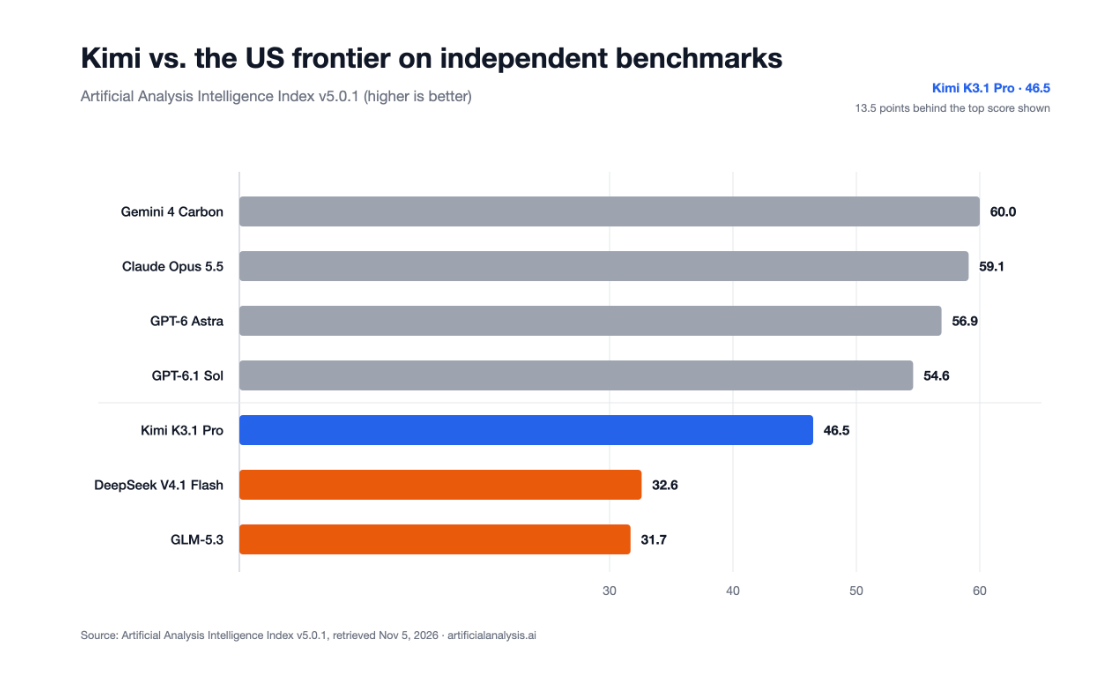
Source: Artificial Analysis Intelligence Index v5.0.1, retrieved November 5, 2026. Higher is better.
K3.1 Pro scores 46.5 on the current Artificial Analysis Intelligence Index. It sits above AA's comparable-model median (42). It is also 13.5 points behind Gemini 4 Carbon and 12.6 behind Claude Opus 5.5, and behind GPT-6 Astra and the much cheaper GPT-6.1 Sol.
If you have seen a "top five" or "fourth overall" figure for Kimi, check the index version. Artificial Analysis re-versioned its composite at the end of October 2026, and older scores are not comparable to the current ones.
The composite hides an uneven profile, which is the more useful thing to look at.
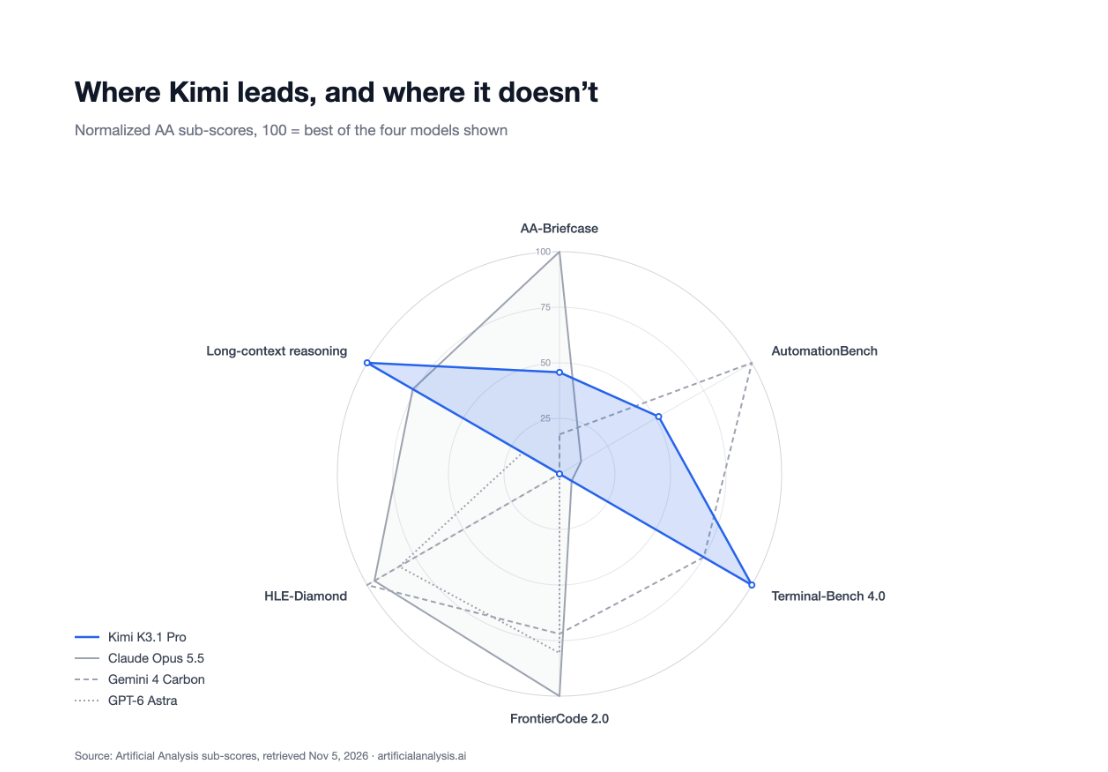
Source: Artificial Analysis sub-scores, normalized per axis across the four models shown, retrieved November 5, 2026.
Kimi's strongest result on AA's harness is Terminal-Bench 4.0, where it scores 67.2%, ahead of Gemini 4 Carbon at 65.2% and Claude Opus 5.5 at 59.6%. Kimi also leads the four on AA's long-context reasoning eval (86.3% against 84.7% for Claude Opus 5.5), and its AA-Briefcase Elo of 1674.8 is second behind Claude. Those are the workloads Moonshot optimized for: terminal tools, multi-step execution, big repositories, documents you can't fit in a normal prompt.
The weak spots are just as clear. On HLE-Diamond, a hard knowledge benchmark, Kimi scores 37.3% against 69.1% for Gemini 4 Carbon and 67.9% for Claude Opus 5.5. On FrontierCode 2.0 it scores 25.5% against Claude's 46.4%. If your application depends on factual recall or on writing code that survives a strict frontier coding eval, Kimi is not the model to reach for first.
On Moonshot's own launch table, K3.1 Pro scored 65.7% on Terminal-Bench 4.0, ahead of GPT-6 Astra at 58.2% and narrowly behind Claude Opus 5.5 at 66.4%. The company also reports 92.7% on BenchCAD with tools and 64.4 on OfficeQA Pro v2. Moonshot's own K3 launch post is blunter about the ceiling: K3 "still trails the most powerful proprietary models, Claude Fable 5 and GPT-5.6 Sol." The K3 technical report is the cleanest evidence Moonshot has published: GPQA Diamond at 93.5 and BrowseComp at 91.2, in one table with the harness stated for each model.
One practical number that doesn't show up in benchmark charts: speed. Artificial Analysis measures K3.1 Pro at 35.7 output tokens per second with a 2.95-second time to first token on Kimi's own API, and describes the model as "notably slow." If you're building an interactive coding assistant, that matters as much as the benchmark gap. The Highspeed variant exists for this reason, at double the token price.
What it costs, and why the sticker price misleads
Kimi's API pricing is simple on the surface. K3.1 Pro is 2.00permillioninputtokensand2.00permillioninputtokensand10.00 per million output tokens. Cache hits cost 0.20permillion.Cachewritescost0.20permillion.Cachewritescost2.00 for a five-minute TTL or 4.00foranhour.Batchinferenceisbilledat604.00foranhour.Batchinferenceisbilledat603/15.K2.7Codeis15.K2.7Codeis0.95/$4.00. There are no context-length tiers on the K3 series, which is a nice change from providers that start charging double after 200K tokens.
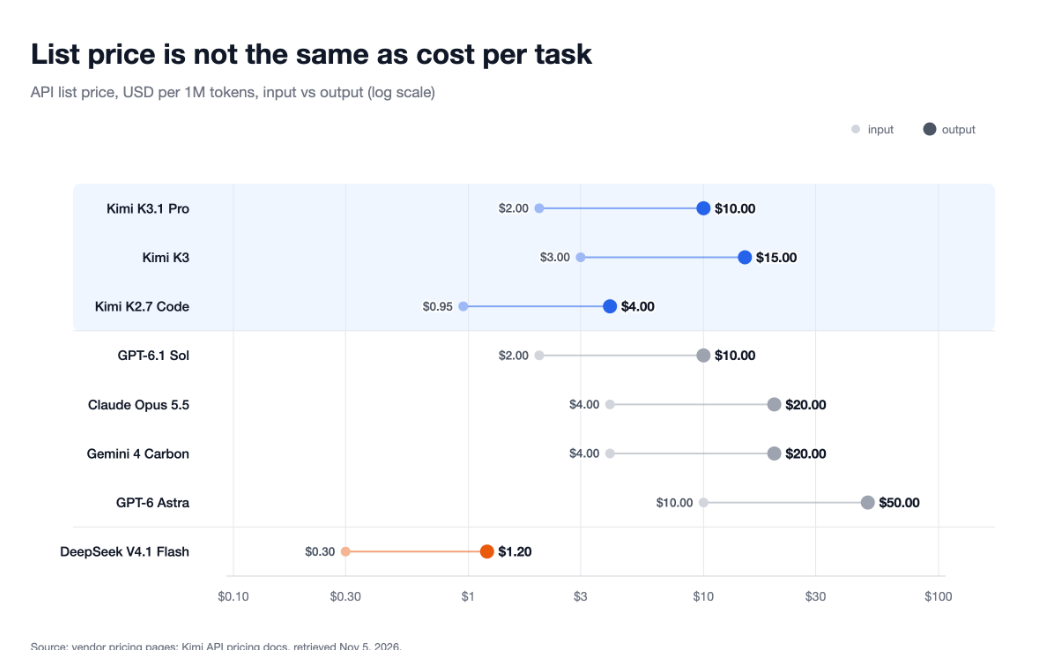
Source: vendor pricing pages, November 5, 2026. Gemini 4 Carbon is shown at its standard 4/4/20 rate; Google lists an introductory 2/2/10, and access to the model is limited.
Against the US frontier, 2/2/10 looks like a discount. It is cheaper than Claude Opus 5.5 at 4/4/20, and much cheaper than GPT-6 Astra at 10/10/50. But two things complicate the story.
First, Kimi is not undercutting the newest US mid-tier. GPT-6.1 Sol is also 2/2/10, and it scores 54.6 on AA's index against Kimi's 46.5. Gemini 4 Carbon is listed at an introductory 2/2/10, with standard pricing set at 4/4/20, though access to that model is limited according to press coverage and AA's listing. The "Chinese model is cheaper" instinct is at least a year out of date at the flagship tier. Kimi's price is competitive, not disruptive.
Second, list price is not what a benchmark run costs. Artificial Analysis measures cost per task using actual token consumption, and K3.1 Pro comes in at 3.68perindextask.ThatischeaperthanClaudeOpus5.5(3.68perindextask.ThatischeaperthanClaudeOpus5.5(10.04) and Gemini 4 Carbon (7.76),butfarmoreexpensivethanGPT−6.1Sol(7.76),butfarmoreexpensivethanGPT−6.1Sol(1.27) and DeepSeek V4.1 Flash ($0.60). The reason is verbosity: K3.1 Pro generated 110 million output tokens during AA's index runs, versus a 64 million median. A model that thinks at length is expensive even at a mid-market per-token rate.
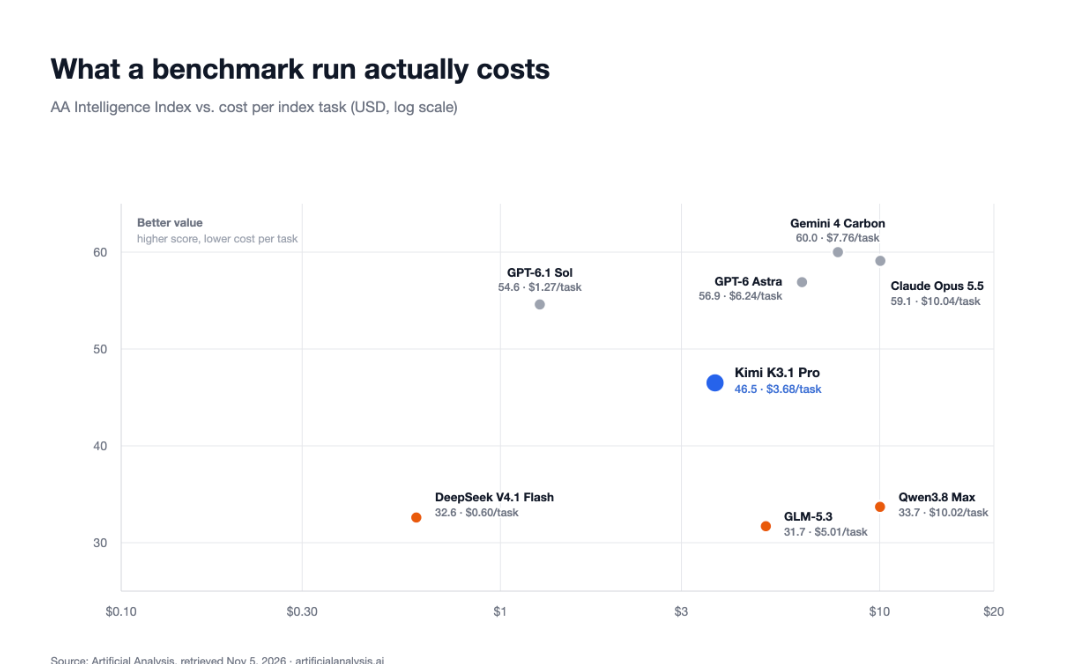
Source: Artificial Analysis, cost per Intelligence Index task, retrieved November 5, 2026. Lower cost and higher score is better.
For agent loops, the cache economics help. A repeated system prompt and tool schema at $0.20 per million cached input tokens is a 90% discount on input, and Moonshot says its official API sees above 90% cache hit rates in coding workloads. If your agent reuses a long prefix all day, the effective input cost is closer to the cache price than the list price. If your agent writes long outputs, the output price is the one that decides your bill.
The consumer plans are separate from the API. Kimi's membership starts at Free (limited usage), then Plus at 19/month(19/month(15/month billed annually), Pro at 39,Maxat39,Maxat99, and Ultra at $199. Kimi Code access starts at Plus; Kimi Claw is included from Pro. The API is pay-as-you-go and is not covered by a membership. If you're evaluating Kimi for a team, decide early whether you're buying seats or tokens, because the two products have different limits.
Calling Kimi from the US
The integration story is boring in the way developers like. Kimi's API is OpenAI-compatible, so the shortest path is the OpenAI SDK with a different base URL and model ID.
from openai import OpenAI

client = OpenAI(
    base_url="https://api.moonshot.ai/v1",
    api_key="...",
)

resp = client.chat.completions.create(
    model="kimi-k3.1-pro",
    messages=[{"role": "user", "content": "Summarize this repository's auth flow."}],
    # K3.1 Pro always reasons; max is the default effort.
    extra_body={"reasoning_effort": "high"},
)
print(resp.choices[0].message.content)
The model IDs you'll use are kimi-k3.1-pro, kimi-k3.1-pro-highspeed, kimi-k3, and kimi-k2.7-code. The K3 series supports 1,048,576 tokens of context, with max_completion_tokens defaulting to 131,072 and allowed up to 1,048,576. Reasoning effort can be set to low, high, or max, and it defaults to max. Lowering it is the simplest way to cut token spend on easier tasks, so measure quality at each level instead of assuming max is free.
Billing is in USD, and cache hits, cache writes, and uncached input are billed separately. Cache entries live for five minutes by default, or an hour if you ask for the longer TTL. Batch requests are supported on K3 and K3.1 Pro at 60% of the standard price.
For the terminal, Kimi Code is the equivalent of Claude Code or Codex CLI. It installs with curl -fsSL https://code.kimi.com/kimi-code/install.sh | bash, or via npm with Node 22.19 or newer. It's a TypeScript TUI agent that reads and edits files, runs shell commands, and supports skills and MCP servers. Moonshot open-sourced the CLI, and it can be pointed at the hosted models with a subscription. Subscribers also get a kimi-for-coding model, currently a K2.8 preview with 1M context, that isn't exposed on the public API.
Two operational notes before you move traffic.
Latency is the first. AA's 35.7 tokens per second is not fast, and network distance from the US can add to it. The Highspeed model doubles the token price for two to three times the speed according to Moonshot. For batch or overnight jobs, ignore this; for interactive tools, it's a real product decision.
Data handling is the second, and it's the one to read carefully. The international API is operated by MOONSHOT AI PTE. LTD. in Singapore. The privacy policy says collected data is stored on servers in Singapore, and the model-use terms are governed by Singapore law with SIAC arbitration. There is no US-region residency option in the docs. Zero Data Retention is available, but only on request for enterprise customers, and it excludes the Batch API and directly uploaded images or videos. The consumer app is a different product with different terms, so don't infer the API's guarantees from the chat product. If US data residency is a hard requirement, this fails that test on the published documents.
Where it fits
Kimi is not going to replace Claude or GPT for the hardest reasoning work today. The independent gap is too large, and Moonshot's own K3 launch post says the model still trails the top proprietary models. What it does have is a combination no US frontier lab sells: open weights, a million-token context, native video input, and coding scores that hold up on agentic tasks.
The comparison that matters most is against the other Chinese labs, not the US ones. DeepSeek V4.1 Flash scores 32.6 on AA, has a 1M context, and costs 0.30/0.30/1.20 at peak with a cache-hit price of $0.006. If you're optimizing cost per token, DeepSeek wins by a wide margin. Kimi costs several times more and scores about 13 points higher, which is a reasonable trade for work that needs better judgment. GLM-5.3 is the cheaper coding option, and Qwen3.8 Max has the broadest ecosystem. Kimi is the capability play.
Beneath the flagship, K2.7 Code is the interesting bargain. It's not on the AA composite index, so the comparison is less rigorous, but 0.95/0.95/4.00 for a 1T-parameter open-weight coding model with 256K context is a different budget category from K3.1 Pro. If you're building a code review bot or an internal coding agent, benchmark it before you pay flagship prices for a task the smaller model handles. Just remember that the K2 series, K2.7 Code included, is being switched off at the end of 2026.
One more thing about self-hosting. If you need open weights because of compliance, vendor risk, or a fine-tune, Kimi is one of the few frontier-adjacent families that actually publishes them. If you need cheap inference, self-hosting a 2.8T-parameter model is not cheaper than the API. The weights are a hedge, not a deployment plan for most teams.
Where Kimi AI will bite you
Easy to miss:
- K2 is going away. New K2 users were cut off October 31, 2026, and all K2 models retire by December 31, 2026. If your code pins
kimi-k2.6, it has weeks, not quarters. - The license is not MIT. K3 and K3.1 Pro use a custom Kimi license with commercial conditions. Read it before you resell inference or ship a large product on it.
- Benchmark provenance matters. Treat the Terminal-Bench 4.0 claim carefully. It is Kimi's strongest result, and the competitor numbers in that table were borrowed from their own reports rather than re-run. The independent AA run also puts Kimi first on TB4, while the composite puts it about 13 points back. Test on your own task.
- Verbosity is a cost center. AA's 110M-token run is the clearest signal that per-token price and per-task cost are different numbers. Measure output length, not just input price.
- The lineup turns over every few months. Pin model IDs, and don't build a migration project around a preview name.
- Speed is a weak spot. 35.7 tokens per second is fine for async work and noticeable in an IDE; AA calls the model "notably slow."
FAQ
Is Kimi AI free?
There is a free tier in the consumer product, with limited usage. The API is not free: K3.1 Pro costs 2.00permillioninputtokensand2.00permillioninputtokensand10.00 per million output tokens, and K2.7 Code costs 0.95/0.95/4.00. Paid memberships start at 19permonth,or19permonth,or15 per month billed annually, and include Kimi Code access from the Plus tier.
What is the best Kimi model right now?
Kimi K3.1 Pro, released October 24, 2026. It's a 2.8-trillion-parameter mixture-of-experts model with 104B active parameters, a 1,048,576-token context window, and native image and video input. The weights were published November 4 under a custom license.
Is Kimi AI open source?
Kimi publishes open weights, but the newer flagship license is not an OSI-approved open-source license. Kimi's K2-series models, including K2.7 Code, used a Modified MIT license; K3 and K3.1 Pro use a custom "Kimi K3.1-Pro License." K2.7 Code is open-weight as well. Check the license file on the Hugging Face repository before commercial use, and note that Artificial Analysis still lists K3.1 Pro as proprietary because its leaderboard has not been updated.
How does Kimi compare to ChatGPT and Claude?
On the independent Artificial Analysis Intelligence Index, Kimi K3.1 Pro scores 46.5, versus 60.0 for Gemini 4 Carbon, 59.1 for Claude Opus 5.5, 56.9 for GPT-6 Astra, and 54.6 for GPT-6.1 Sol. Kimi is above AA's comparable-model median but behind the US frontier. Its advantages are open weights, a 1M-token context, and lower list prices than Opus or Astra; its disadvantages are weaker knowledge recall, weaker frontier coding scores, slower output, and a custom license.
Does Kimi AI work in the US?
Yes. The API is reachable at https://api.moonshot.ai/v1 and bills in USD; the international operator is Moonshot's Singapore entity, and the consumer apps are listed on the major app stores. Data is stored in Singapore and there's no US-region option, so review the data-processing terms and ask about Zero Data Retention before production use.
How do I use Kimi with Python?
Install the OpenAI SDK, point base_url at https://api.moonshot.ai/v1, and use a Kimi model ID such as kimi-k3.1-pro. The request shape is the same Chat Completions call you already use. Kimi's docs also list Anthropic-style and Responses-compatible endpoints if your codebase is built around those APIs.
What is Kimi Claw?
Kimi Claw is a browser-hosted way to run an always-on agent built on the open-source OpenClaw framework. It launched in beta in mid-February 2026 and includes cloud storage and a skills library, so you don't need a server or Docker to keep an agent running. It's included in the Pro membership tier and above.
Sources
- Kimi K3.1 Pro launch post and K3.1 Pro pricing explainer — Moonshot AI, October 2026
- Kimi K3 launch post — Moonshot AI, July 2026
- Kimi K3 technical report (arXiv 2607.24653) — Moonshot AI, August 2026
- Kimi K2.5 launch post, Kimi K2.6 launch post — Moonshot AI, January and April 2026
- Kimi K2.7 Code resource page — Moonshot AI, updated October 2026
- Kimi Agent product history — Kimi Help Center, accessed November 5, 2026
- Kimi API pricing and K2 retirement notice — Kimi API Platform, accessed November 5, 2026
- Kimi K3.1 Pro weights and license — Hugging Face (Moonshot AI org), November 2026
- Kimi membership pricing — Kimi Help Center, accessed November 5, 2026
- Kimi API model-use terms, privacy policy, and Zero Data Retention guide — Kimi API Platform, accessed November 5, 2026
- Kimi Code CLI documentation and Kimi Code release notes — Moonshot AI, accessed November 5, 2026
- Kimi K3.1 Pro model page and AA leaderboard — Artificial Analysis, retrieved November 5, 2026
- GPT-6 Astra model page and OpenAI API pricing — OpenAI, accessed November 5, 2026
- Anthropic pricing — Anthropic, accessed November 5, 2026
- Introducing Gemini 4 Carbon — Google, October 2026
- DeepSeek models and pricing — DeepSeek, accessed November 5, 2026
- Moonshot AI valuation and IPO reporting — Bloomberg via Euronews, October 2026
- Moonshot pauses Kimi subscriptions amid demand — Reuters via Asahi Shimbun, July 2026