

Nano Banana 2.1 vs Pro vs Lite: Which Google Image Model Should You Use?
We ran Nano Banana 2.1, Nano Banana Pro and Nano Banana 2 Lite through the same two prompts, three times each. Spelling tied, Pro was slightly better on punctuation, and Pro got a ten-item scene right only once in three.
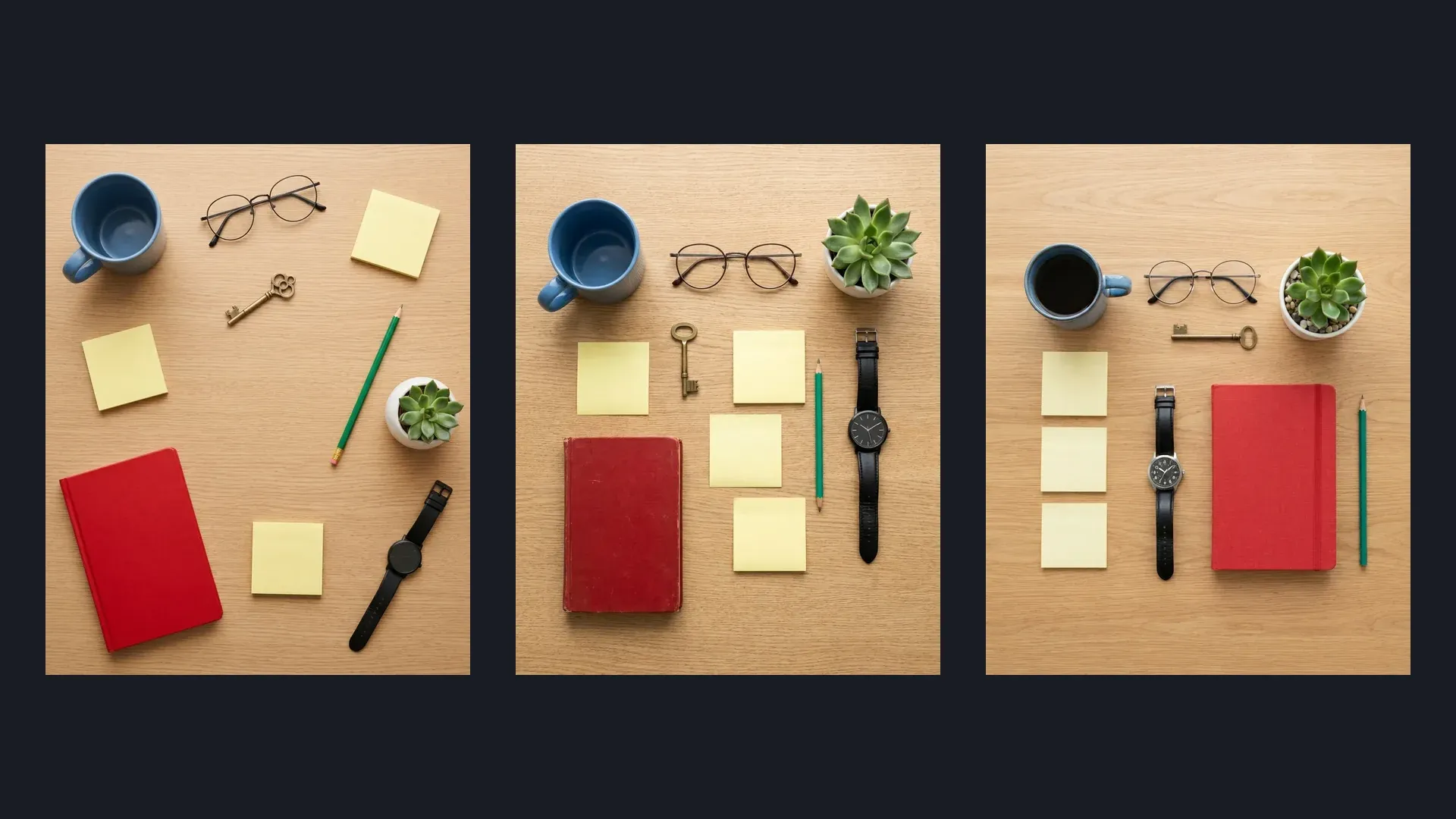
In our Nano Banana 2.1 vs Pro tests, spelling and capitalization were a tie, and Pro got the punctuation exactly right in 2 of 3 runs against 1 of 3 for 2.1. On a ten-item desk scene the result flipped: 2.1 got the items right 3 times out of 3, while Pro added a stray object in two runs. At 1K, 2.1 costs a quarter of Pro's list price.
We added Nano Banana 2 Lite because its name suggests the budget pick. At 1K it isn't, at least for the image itself: a Lite image costs exactly what a 2.1 image does. It matched 2.1 on counting and finished last on exact text.
Nano Banana 2.1 vs Pro vs Lite at a glance
If you need… | Use | Based on |
|---|---|---|
Punctuation exactly as written | Nano Banana Pro, narrowly | 2 of 3 exact runs against 1 of 3 for 2.1; spelling and casing tied |
The right items in a busy scene | Nano Banana 2.1 or Lite | 3 of 3 each; Pro 1 of 3 |
2K or 4K output with 4:1 or 8:1 banners | Nano Banana 2.1 | Lite is 1K only; Google lists the extra-wide ratios for 2.1, not Pro |
Style reference images or five consistent characters | Nano Banana Pro | Of the documented limits, only Pro lists these |
Long prompts at 1K | Nano Banana 2 Lite | Cheapest input and thinking rates of the three |
Specs and official pricing side by side
From Google's model pages, the image generation guide and the Gemini API pricing page, checked on November 6, 2026:
Nano Banana 2.1 | Nano Banana Pro | Nano Banana 2 Lite | |
|---|---|---|---|
Model ID |
|
|
|
Output sizes | 1K, 2K, 4K | 1K, 2K, 4K | 1K only |
Extra-wide ratios (1:4, 4:1, 1:8, 8:1) | Yes | Not listed | No |
Reference images | 10 objects, 4 characters | 6 objects, 5 characters, 3 style | Not listed |
Search grounding | Web and Image Search | Google Search | Not supported |
Thinking | minimal, medium, high (default medium) | Built in | minimal, high (default minimal) |
Image output, 1K / 2K / 4K | $0.0336 / $0.0504 / $0.113 | $0.134 / $0.134 / $0.24 | $0.0336 (1K only) |
Input, per 1M tokens | $1.50 | $2.00 | $0.25 |
Text and thinking output, per 1M tokens | $7.50 | $12.00 | $1.50 |
The image price isn't the whole bill. Every call also pays for the prompt and for thinking tokens. A 2,000-token prompt adds $0.003 on 2.1, $0.004 on Pro and $0.0005 on Lite, and every 1,000 thinking tokens adds $0.0075, $0.012 and $0.0015 respectively. 2.1 thinks at medium by default and Lite at minimal, so a Lite call should come out cheaper even though its image is priced the same. We couldn't see per-call token counts in our runs, so we can't tell you by how much.
Google calls Pro "the premium choice for complex visual tasks", built to follow complex instructions and render high-fidelity text. Google's model card puts 2.1 (with thinking) at 1050 on overall human preference and Pro at 935, as reported by The Next Web.
If you run these models on MuseSpark, Nano Banana 2.1 and Pro are both billed below Google's list rates.
Which model copies text exactly?
We asked for a festival poster whose small print is full of easy-to-miss punctuation: periods in abbreviations, an ampersand and en dash, middle-dot separators, and a plus sign in parentheses. The prompt told the model to keep capitalization and punctuation exactly as written. Each model ran it three times at 1K and 4:5, at its default settings, on MuseSpark, the model platform we build.
A printed event poster pinned to a cork board, photographed straight on. The poster text must read exactly as written, with the same capitalization and punctuation. Headline: "Harbor Lights Festival". Subtitle: "Live music & food trucks". Small print at the bottom: "Sat. Nov. 22 – 6:00 p.m. to 11:00 p.m. · Pier 7, Gate C · Free entry (ages 18+)". Clean modern layout, navy and coral colors, soft daylight.
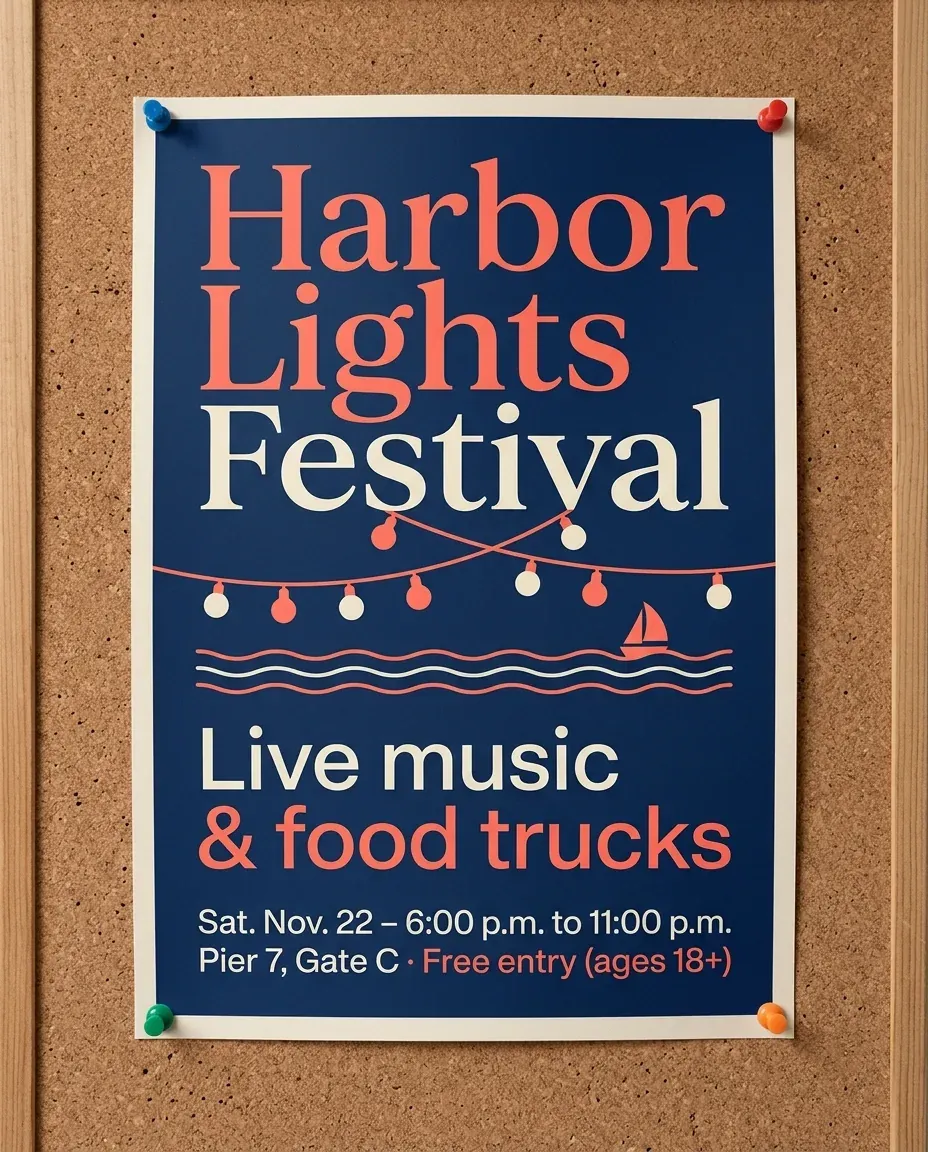
Nano Banana 2.1, run 1 of 3: middle dot dropped at the line break
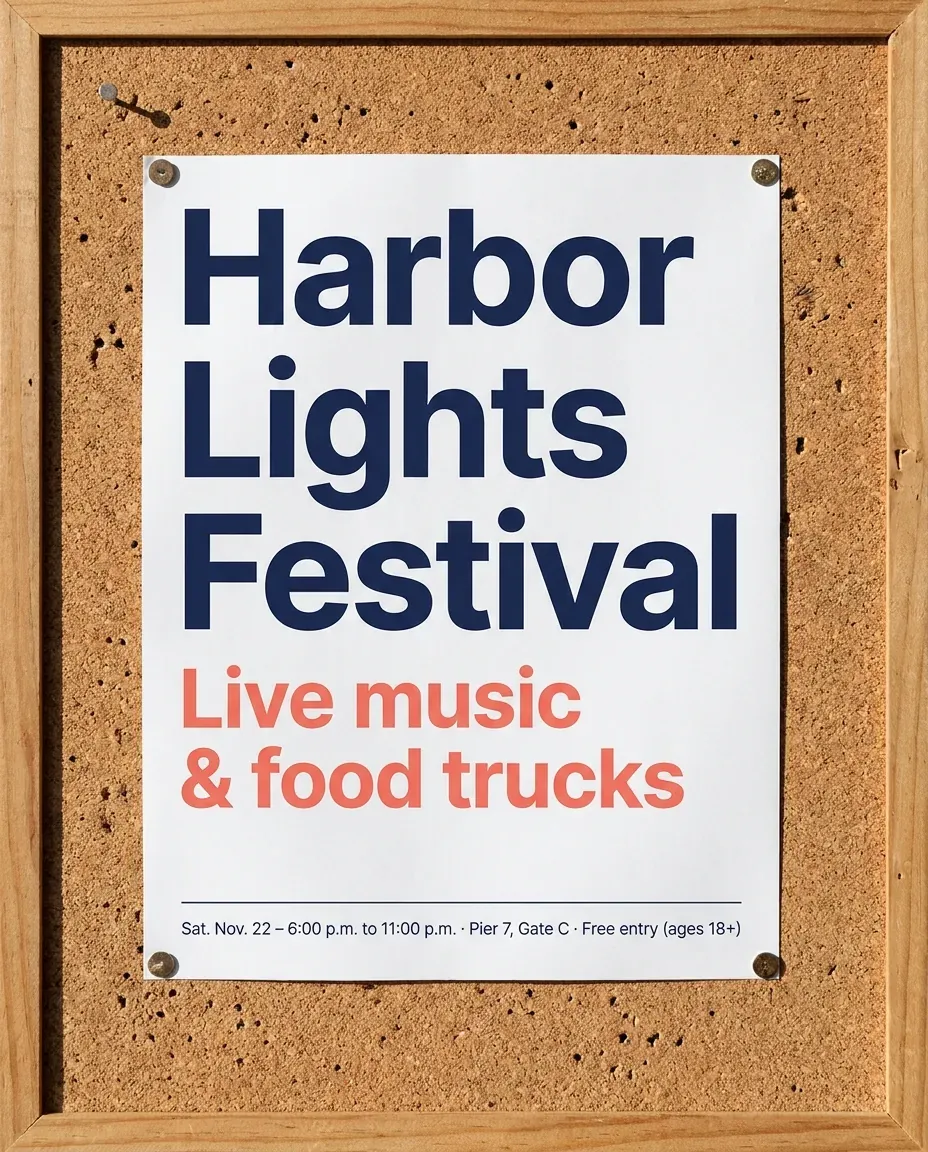
Nano Banana Pro, run 1 of 3: exact match
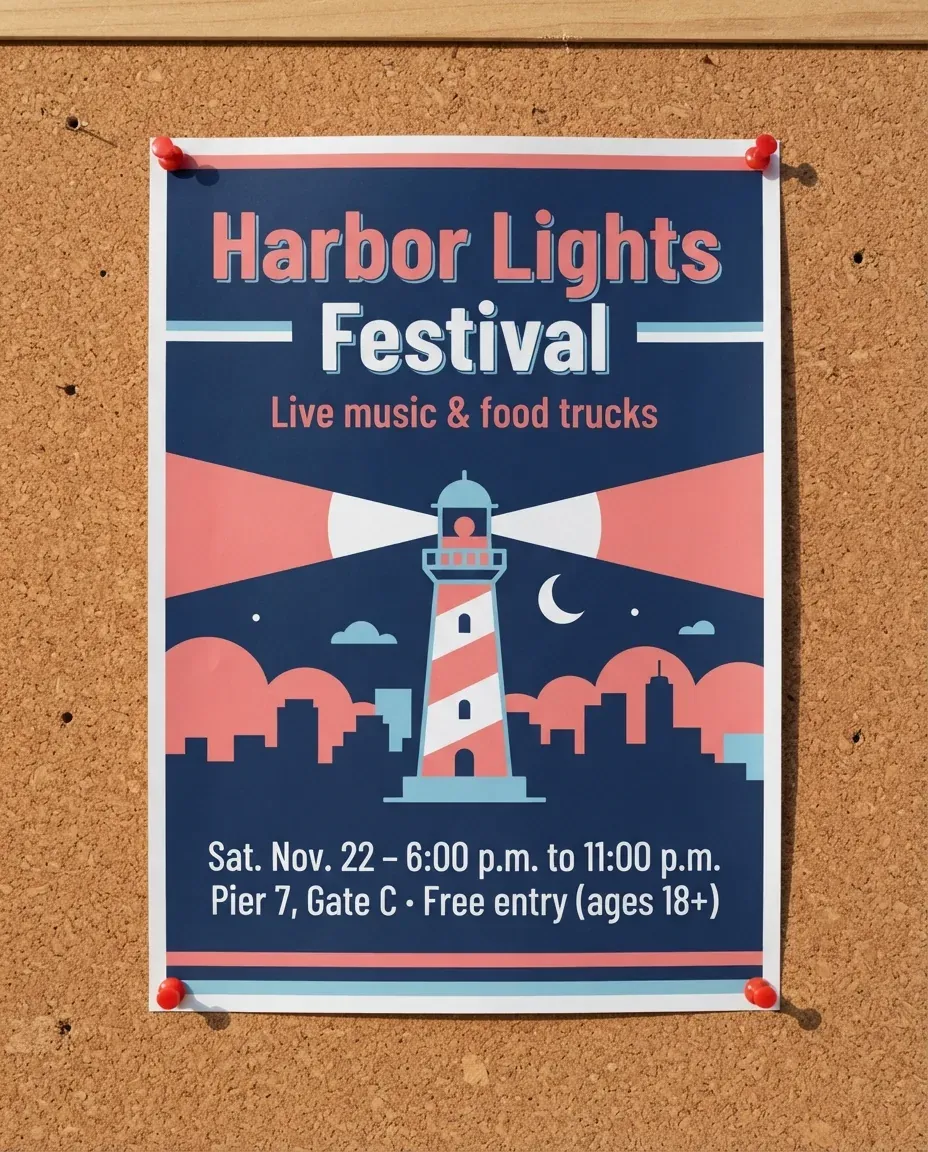
Nano Banana 2 Lite, run 1 of 3: middle dot dropped at the line break
Across 3 runs each | Nano Banana 2.1 | Nano Banana Pro | Nano Banana 2 Lite |
|---|---|---|---|
Every word spelled correctly | 3 of 3 | 3 of 3 | 3 of 3 |
Capitalization as written | 3 of 3 | 3 of 3 | 1 of 3 |
Punctuation as written | 1 of 3 | 2 of 3 | 0 of 3 |
Exact match overall | 1 of 3 | 2 of 3 | 0 of 3 |
Nobody misspelled anything. Most punctuation misses happened where the small print wrapped onto a second line and the middle dot at the break disappeared: twice for 2.1, once for Pro and once for Lite. Lite also set the headline in all caps in two runs and swapped the middle dots for heavier "•" bullets.
An r/GeminiAI user who compared 2.1, Nano Banana 2 and Pro on a different poster in a three-way test also found Pro the most exact on casing and punctuation. Their 2.1 turned periods into bullet dots, the same kind of substitution we saw from Lite.
All three Pro posters used the same layout: navy type on white with a coral subtitle. 2.1 and Lite produced a different illustrated design in every run.
Which model gets the object count right?
Next, a top-down desk shot with ten specific items, three of them separate sticky notes, and nothing else.
Top-down flat lay photo on a light oak desk. Exactly these items and nothing else: one blue ceramic mug, one pair of round glasses, one brass key, three separate yellow sticky notes (not stacked, not overlapping), one green pencil, one small succulent in a white pot, one closed red notebook, and one black wristwatch. No writing or text anywhere in the image. Soft even daylight, photorealistic.

Nano Banana 2.1, run 1 of 3: all ten items
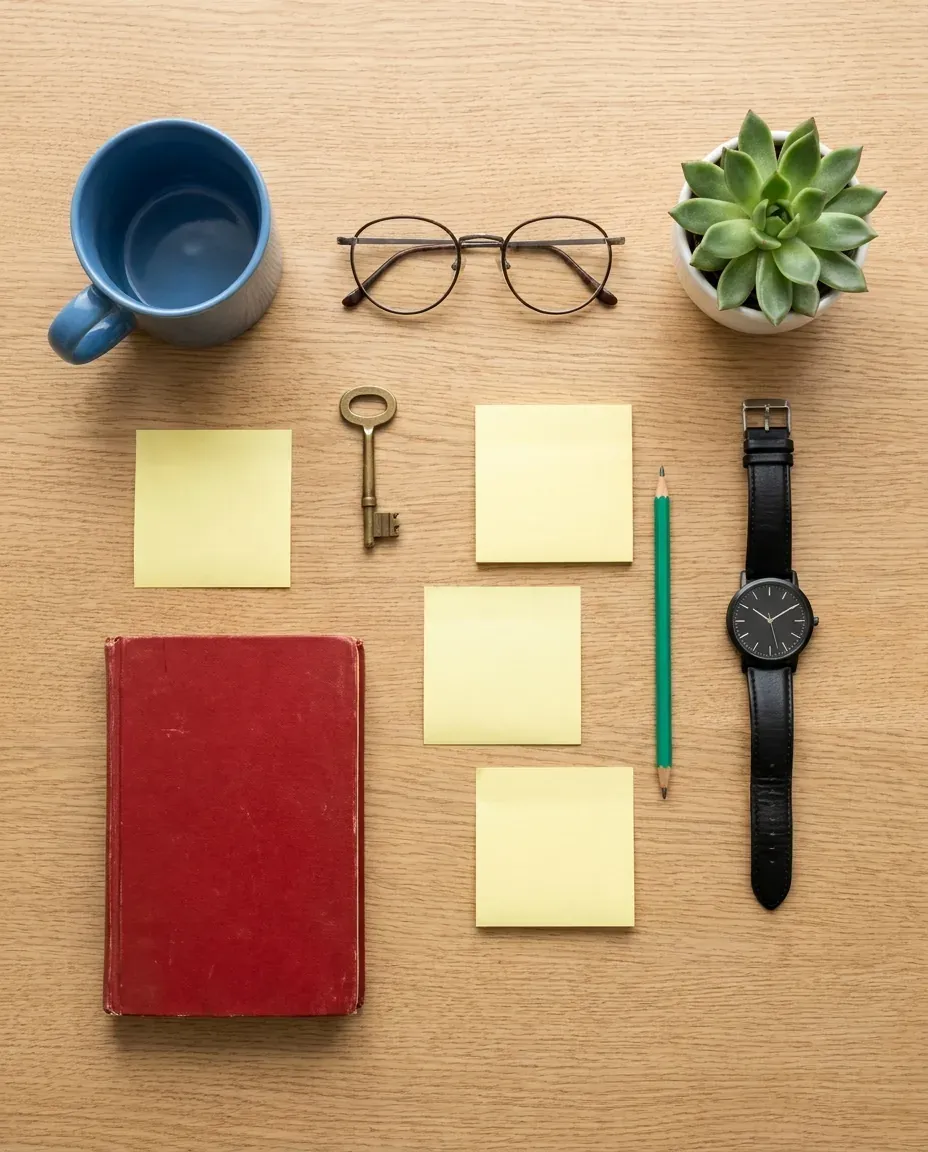
Nano Banana Pro, run 1 of 3: four sticky notes instead of three

Nano Banana 2 Lite, run 1 of 3: all ten items
Across 3 runs each | Nano Banana 2.1 | Nano Banana Pro | Nano Banana 2 Lite |
|---|---|---|---|
Exactly the ten requested desk items | 3 of 3 | 1 of 3 | 3 of 3 |
Extra desk objects added | 0 of 3 | 2 of 3 | 0 of 3 |
Any text in the image | 0 of 3 | 0 of 3 | 0 of 3 |
Pro drew a fourth sticky note in one run and a second succulent in another. Its third run had the right items but wasn't top-down: the mug is shown from the side, the watch sits on the notebook, and two items are cut off at the frame edge.
We only counted loose desk objects. Read "nothing else" strictly and Lite slips too: it filled the mug with coffee in two runs and showed a window at the edge of the frame in one.
The r/GeminiAI tester also caught Pro miscounting, in the other direction: asked for three sticky notes, it drew two. Two small tests aren't proof, but if a layout depends on exact quantities, count what Pro gives you.
What a usable image actually costs
When a model fails part of the time, the list price understates what you pay for an image you can use. Dividing Google's 1K image price by the share of runs that passed the tables above gives a rough figure, before prompt and thinking tokens:
Cost per usable 1K image | Nano Banana 2.1 | Nano Banana Pro | Nano Banana 2 Lite |
|---|---|---|---|
Poster with exact copy | about $0.10 (1 of 3) | about $0.20 (2 of 3) | no usable run (0 of 3) |
Desk scene with the right items | $0.0336 (3 of 3) | about $0.40 (1 of 3) | $0.0336 (3 of 3) |
These rest on three runs per model, so read them as rough guides. In a Nano Banana 2.1 vs Pro decision at 1K, Pro costs four times as much per image, so it only comes out cheaper per usable image if it succeeds four times as often, and it didn't come close. At 4K the price gap narrows to about 2.1x, and on the poster test the two land almost level: about $0.34 for 2.1 against $0.36 for Pro. What Pro mainly saves is review rounds, and it still needs proofreading, since it dropped a middle dot once in three runs.
What 2.1 users complain about
Our prompts were neutral, so they don't test the complaint that comes up most in Nano Banana 2.1 threads. A popular r/GeminiAI thread, "Nano Banana 2.1 is completely deaf", describes 2.1 quietly rewriting prompts, especially around clothing and anything a filter might flag. One commenter asked for two boxers fighting and got two men high-fiving in a garden. Another argued that Nano Banana 2 Lite follows prompts better than 2.1.
The original poster in that thread was worried Google would retire Pro. Google hasn't announced a shutdown date for gemini-3-pro-image, and the Flow team said at launch that Pro and Nano Banana 2 Lite stay available next to 2.1. We haven't tested borderline prompts, so if your work involves fashion, sports action or anything near a content filter, run your own prompts through 2.1 and Pro before switching.
When to switch models
Start new work on 2.1. It ties Lite for the lowest 1K image price, costs between a quarter and about half of Pro's price at every size, and is the only one of the three that combines 2K and 4K output with the extra-wide ratios. Google's image generation guide also tells new projects to use 2.1 instead of Nano Banana 2.
Move to Pro for the final render when exact copy matters and a review round is expensive: packaging, legal lines, event details a client will check line by line. It's also the route for style references and five characters. The Nano Banana Pro model page lists its parameters.
Use Lite for 1K drafts where prompts are long and calls are frequent, and keep it away from text and anything that needs search grounding. Its options are on the Nano Banana 2 Lite model page.
FAQ
Is Nano Banana 2.1 better than Nano Banana Pro?
On our two prompts, 2.1 tied or beat Pro on everything except punctuation, where Pro was ahead by one run in three. Google's model card also rates 2.1 higher on overall human preference. Pro remains the documented choice for style references and up to five consistent characters.
Is Nano Banana Pro being discontinued?
Not as of November 6, 2026. The stable gemini-3-pro-image model went generally available on May 28, 2026 and is still on Google's pricing page. What was shut down, on June 25, 2026, was the older preview ID, gemini-3-pro-image-preview.
Is Nano Banana 2 Lite cheaper than Nano Banana 2.1?
The image costs the same, $0.0336 at 1K. Lite's input and thinking tokens are much cheaper ($0.25 against $1.50 per million for input) and it thinks less by default, so each call should cost somewhat less. It can't output above 1K.
Can Nano Banana 2.1 use style reference images?
Google's reference table doesn't list style references for 2.1; it allows up to 10 object images and 4 character images. Style references (up to 3) are listed only for Nano Banana Pro. We didn't test whether 2.1 picks up a style from a general reference image.
To try all three on your own prompts, Nano Banana 2.1, Pro and 2 Lite are available on MuseSpark with pay-as-you-go pricing and no subscription.
Sources
- Google AI for Developers: Gemini Nano Banana 2.1 model page
- Google AI for Developers: Gemini 3 Pro Image (Nano Banana Pro) model page
- Google AI for Developers: Gemini 3.1 Flash Lite Image (Nano Banana 2 Lite) model page
- Google AI for Developers: Image generation with Gemini
- Google AI for Developers: Gemini API pricing
- Google AI for Developers: Gemini API changelog
- The Next Web: Google moves free Gemini to Flash-Lite and launches Nano Banana 2.1
- Flow by Google on X: Nano Banana 2.1 in Google Flow
- Reddit, r/GeminiAI: Nano Banana 2.1 vs Nano Banana 2 vs Nano Banana Pro on the same four prompts
- Reddit, r/GeminiAI: Nano Banana 2.1 is completely deaf