

Hunyuan 4 vs Hunyuan 3: Specs, Pricing, and When to Use Each
HY4 is bigger, multimodal, and 6.3x the input price of HY3. A developer's guide to specs, benchmarks, USD pricing, and when each model fits.
Tencent released Hy4 on November 4, 2026. The announcement says Hunyuan has joined the top tier of open models, which is the sort of sentence every lab writes on launch day. The part worth your attention is narrower.
If Hy3 is already in your stack, or you are shopping for a cheap model to run a coding agent, you need two things from a comparison post. What Hy4 can do that Hy3 cannot, and what that costs per call.
The first answer fits in a phrase: images and computer use. The second is less comfortable. Hy4 lists at $0.834 per million input tokens against Hy3's $0.132. Output runs $2.501 versus $0.528. That is 6.3× on input and 4.7× on output, before a temporary discount.
Tencent styles the names Hy3 and Hy4. Outside China you will also see them written as Hunyuan 3 and Hunyuan 4, or HY3 and HY4. Same models.
The short version
Five things separate them, and only one is a raw capability gap.
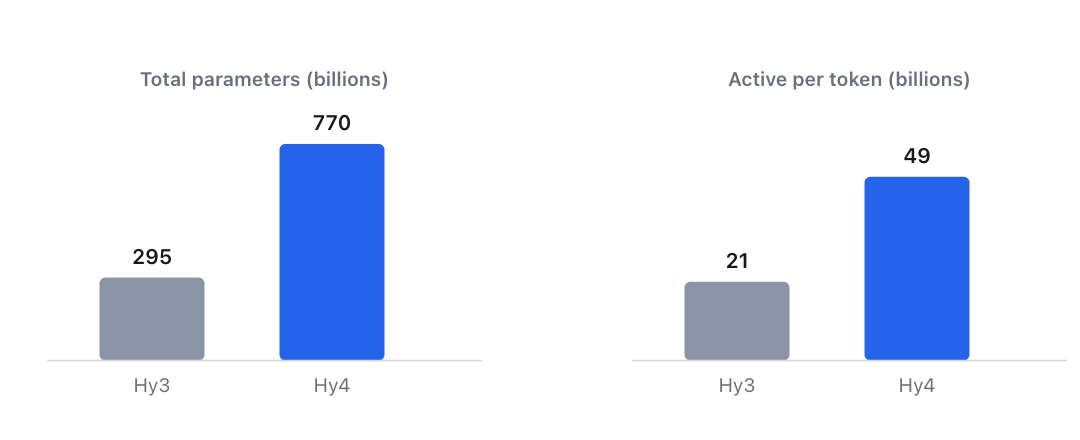
- Scale: Hy4 is 770B total parameters with 49B active. Hy3 is 295B with 21B active.
- Context: 1M tokens versus 256K, though the API caps input at 960K and 192K respectively.
- Modality: Hy4 takes images and can drive a GUI. Hy3 is text-only.
- Price: $0.834 in / $2.501 out per million tokens against $0.132 / $0.528. Hy4 bills at half price until December 31, 2026.
- Distribution: Hy3 ships Apache 2.0 weights you can download today. Hy4's weights are announced, not released.
That last point is the one people miss, so it is worth saying plainly: for all the benchmark talk, the weights you can put on your own hardware this week belong to the previous generation.
What changed in Hy4
Both are sparse mixture-of-experts models, and the activation ratio matters more than the round number on the slide. Hy3 touches about 7 percent of its weights per token. Hy4 touches about 6.4 percent. Total parameters grew 2.6×, but the compute per token grew 2.3×. If you were budgeting off the headline figure, you were budgeting a bit high.
Apr 23, 2026Hy3 previewJul 6, 2026Hy3 GA,Apache 2.0Aug 28, 2026Hy4 preview,1M contextNov 4, 2026Hy4 GA, visionand computer use
Hy3 | Hy4 | |
|---|---|---|
Released | July 6, 2026 | November 4, 2026 |
Total / active parameters | 295B / 21B | 770B / 49B |
Layers | 80 | 78 |
Experts | 192 routed, top-8 | 256 routed + 1 shared, top-8 |
Attention | GQA, 64 heads / 8 KV | Gated DeepSeek Sparse Attention |
Context / API input cap | 256K / 192K | 1M / 960K |
Max output | 128K | 64K |
Input modalities | Text | Text, images |
Computer use | No | Yes |
Weights | Apache 2.0, on Hugging Face | Announced, system card pending |
List price per 1M tokens | $0.132 in / $0.528 out | $0.834 in / $2.501 out |
Hy4's layer, expert, attention and MTP rows come from the preview model card, since Tencent has not published a separate GA architecture table. Parameter counts and prices above are GA figures.
Total parameters (billions)295Hy3770Hy4Active per token (billions)21Hy349Hy4
Each pair is total parameters on the left, active parameters per token on the right.
The context window grew; the output ceiling shrank
One million tokens reads like four times the room. By the API's input cap it is closer to five: 960K usable against Hy3's 192K.
The output side goes the other way. Hy3 allows up to 128K output tokens. Hy4 allows 64K. If your agent writes whole files, long diffs, or complete reports in a single pass, that is a downgrade, and launch posts rarely mention it. You will find it in the TokenHub API reference, in the same table as the context number.
Vision is the real feature gap
Hy4 is the first model in this line that can look at something. Tencent's examples are specific: locating a roughly two-meter roof component inside a 2.8-gigapixel aerial image, reassembling a 900-piece jigsaw into a Monet painting, reading charts, and checking a photo against a location claim.
It also supports computer use, meaning it can work through a graphical interface and a command line. Tencent says it ran targeted training on Blender and CAD workflows and on long tasks that span several applications. Treat vendor demos as demos. The useful question is whether screenshot-driven debugging and browser automation work on your own pages, and that only shows up in a trial.
Under the hood: wider, with a different attention layer
Hy3 has 80 layers, a 4,096-wide hidden state, and a 3.8B-parameter multi-token-prediction layer for speculative decoding. Hy4 drops to 78 layers but widens the hidden state to 6,144, adds a shared expert next to the 256 routed ones, and swaps plain grouped-query attention for sparse attention with a cross-layer index cache. Its MTP layer is 10B parameters, 0.7B active.
The practical consequence is memory, and it is not subtle. Hy3 in BF16 is roughly 590GB of weights. Hy4 is about 1.5TB. More on that below.
Benchmarks: what Tencent published, and what it didn't
Two numbers survive as a clean cross-generation comparison, and both come from the August preview launch.
On DeepSWE, a software-engineering agent benchmark, Hy3 scored 28.0 and Hy4 preview scored 64.3. On Terminal-Bench 2.1, the gap narrows: 70.8 to 85.4.
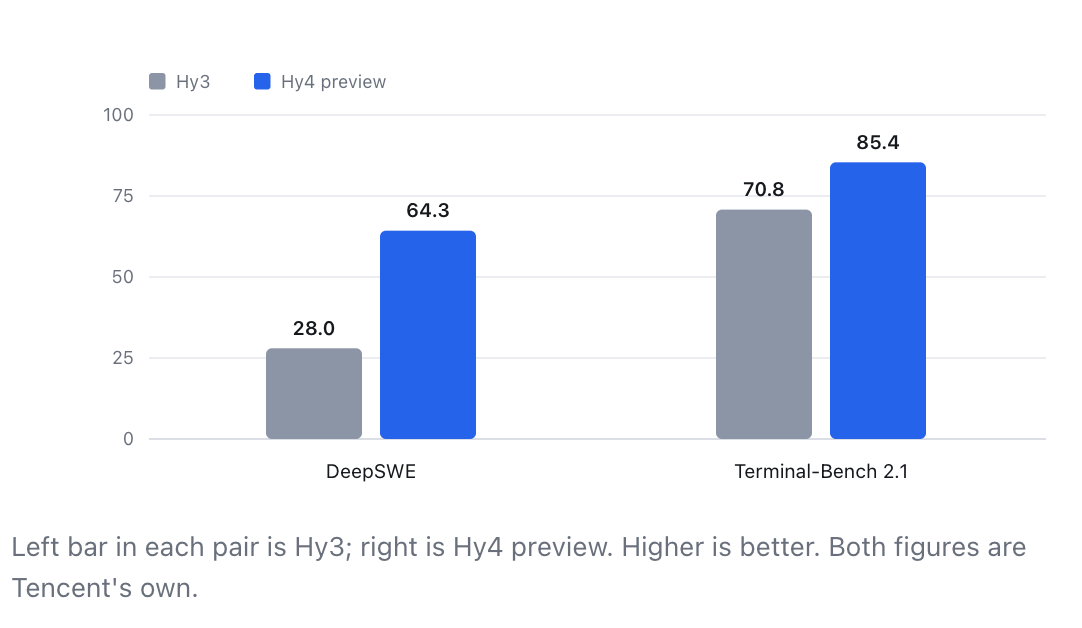
Left bar in each pair is Hy3; right is Hy4 preview. Higher is better. Both figures are Tencent's own.
The DeepSWE jump is the more interesting signal. Terminal-Bench measures whether an agent can finish a terminal task, and 14.6 points is respectable without being a rewrite of what the model can do. Doubling a long-horizon coding score suggests the agent loop survives longer before it falls apart, which is the failure mode that actually hurts in production.
The November GA note reports against a different baseline: Hy4 preview, not Hy3. GameDev up 19.1%, GameLogic up 9.8%, the IRAB investment-research benchmark up 12.03 points. Useful if you already run Hy4 preview. Not a fresh head-to-head with Hy3 on the same public suites. If that is the number you want, you are extrapolating.
Hy3's own published numbers lean toward product results. A blind evaluation Tencent ran with 270 experts scored it 2.67 out of 4 against GLM-5.1's 2.51, with the widest margins in frontend work, data and storage, and CI/CD. Tencent also says SWE-Bench Verified variance across CodeBuddy, Cline and KiloCode stayed within 4 percent, which is a more useful claim than any single score if you switch scaffolds.
One caution on the reliability figures. Hy3 reports hallucination dropping from 12.5% to 5.4% on an internal set. Hy4 reports two different pairs, depending on the page you read: 15.76% to 5.45% on the research site, 12.95% to 7.2% in the press release. Different test sets, no shared baseline. Directionally, every model improved. Numerically, you cannot line these up.
Hy4 vs Hy3 pricing in USD
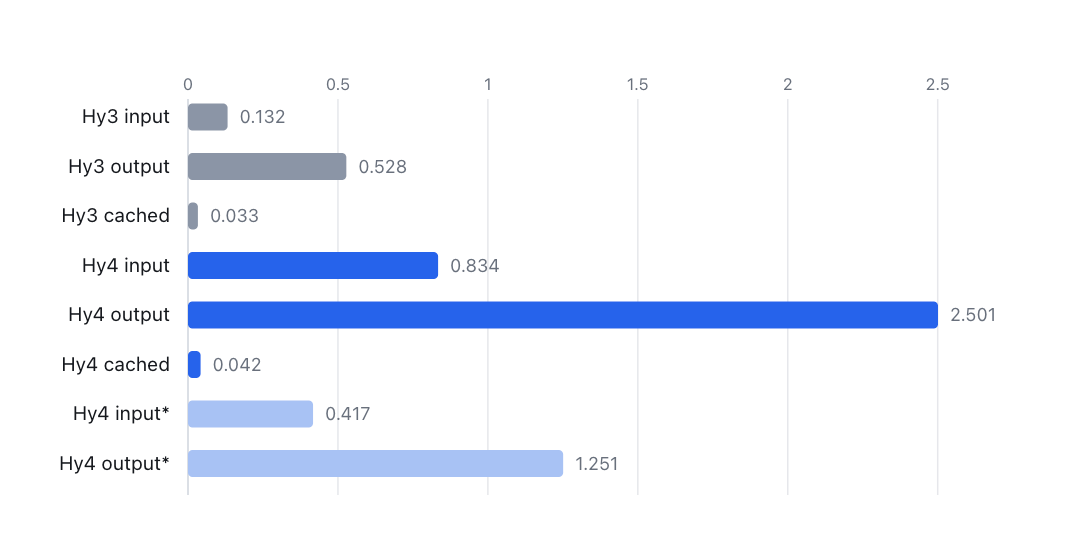
TokenHub's international list price, checked November 5, 2026. Bar length is proportional to price; the cache rows are almost invisible at this scale.
00.511.522.5Hy3 input0.132Hy3 output0.528Hy3 cached0.033Hy4 input0.834Hy4 output2.501Hy4 cached0.042Hy4 input*0.417Hy4 output*1.251
USD per 1M tokens on TokenHub, list price, November 5, 2026. * 50% launch discount, ends December 31, 2026.
Hy3 stays one of the cheapest capable models on the market. Hy4 is not expensive by frontier standards either, about a quarter of Kimi K3.1 Pro's output price, but it sits in a different bracket from its own predecessor.
Two calls, two bills
Workload | Tokens | Hy3 | Hy4 | Hy4 at 50% |
|---|---|---|---|---|
PR review | 50K in, 2K out | $0.0077 | $0.0467 | $0.0234 |
Repo sweep | 900K in, 10K out | Not possible in one call (192K input cap) | $0.776 | $0.388 |
The second row is the case for Hy4 in one line. Chunking a 900K-token codebase through a 192K window means five passes, and each pass loses the context that made the other four useful. Hy4 does it in one request for under a dollar. Whether that is a good deal depends on what the answer is worth to you.
Cache hits narrow the gap
This is the part I would check before writing off Hy4 on price. A cache hit costs $0.042 per million tokens on Hy4 and $0.033 on Hy3. That is a 1.27× difference, not 6.3×.
If your traffic carries a large, stable system prompt and a small changing question, most of your input is cached. At an 80 percent hit rate the blended input price comes to about $0.053 for Hy3 and $0.200 for Hy4. That is 3.8×, not 6.3×. Run the arithmetic on your own hit rate before you decide. Mine assumes you have caching turned on, which is not the default everywhere.
Self-hosting Hy3 vs Hy4
If self-hosting is a requirement, the decision is already made. Hy3 has Apache 2.0 weights on Hugging Face, BF16 and FP8 variants, vLLM and SGLang recipes, finetuning documentation, and a GRPO training path. Tencent plans to release Hy4's GA weights and a system card. What exists today is Hy4 preview, also Apache 2.0.
Memory is where it gets real. 295B in BF16 is roughly 590GB before KV cache, which a node of eight 96GB cards can hold. Tencent's own recipe names H20-3e, a China-market part, so stateside deployments end up on H200-class hardware or multiple nodes. Hy4 at 770B is about 1.5TB in BF16. The shipping recipe avoids that by running the FP8 checkpoint on eight GPUs at tensor-parallel 8, which lands near 770GB.
If you use vLLM, one flag changes on the way from Hy3 to Hy4: the tool-call parser goes from hy_v3 to hy_v4, and the reasoning parser changes with it. SGLang users get an updated cookbook instead.
Which model should you use?
1Images, screenshots, or GUI control?Yes → Hy4No ↓
2More than 192K tokens in one request?Yes → Hy4No ↓
3Need weights you can host today?Yes → Hy3No ↓
4Is per-call cost the binding constraint?Yes → Hy3No ↓
5Frontend, game, finance, or document work?Yes → Hy4No → Hy3
Hy3 | Hy4 | |
|---|---|---|
Text and code generation | Yes | Yes |
Image input | No | Yes |
Computer use | No | Yes |
Max input per request | 192K | 960K |
Max output per request | 128K | 64K |
Self-host today | Yes, Apache 2.0 | Preview weights only |
OpenAI Chat Completions API | Yes | Yes |
OpenAI Responses / Anthropic Messages | Not listed | Yes |
Four profiles, in plain terms.
High-volume text and code. Hy3. At $0.132 per million input tokens it runs about one-fifteenth of Kimi K3.1 Pro's $2 input price, and Tencent's own WorkBuddy numbers (72 percent task success on preview, 90 percent on GA, with completion time down 34 percent) say it clears the bar for document and coding work. It also uses fewer tokens per task than a larger rival: Tencent claims 47.4 percent fewer than GLM-5.2 on document processing and 49 percent fewer on presentation drafting. Token efficiency compounds with a low unit price, which is why the per-task gap is often wider than the per-token one.
Anything with pixels. Hy4, and there is no second option in this family. Screenshot debugging, chart extraction, UI verification, form filling: Hy4 is the only one that sees.
Long-horizon repository work. Hy4, with a caveat. The 960K input window is the feature; the 64K output cap is the tax. Plan for multi-turn assembly rather than one giant patch.
Regulated or offline deployment. Hy3, today. Hy4's license and system card are not out yet, and you cannot audit weights that do not exist.
Migrating from Hy3 to Hy4
The API surface is friendly. Hy4 is OpenAI Chat Completions compatible, and it also speaks the OpenAI Responses and Anthropic Messages protocols, so an existing client usually needs a base URL and a model string.
from openai import OpenAI
from openai import OpenAI

client = OpenAI(
    api_key="YOUR_API_KEY",
    base_url="https://tokenhub-intl.tencentcloudmaas.com/v1",
)

resp = client.chat.completions.create(
    model="hy4",                    # "hy3" still works, same endpoint
    messages=[{
        "role": "user",
        "content": [
            {"type": "text", "text": "What is wrong with this chart?"},
            {"type": "image_url",
             "image_url": {"url": "https://example.com/chart.png"}},
        ],
    }],
    max_tokens=8192,                # Hy3 allows 128K, Hy4 allows 64K
    extra_body={"reasoning_effort": "high"},
)
Four things to fix before you flip the model string.
Output ceiling. Anything that asks for more than 64K tokens in one response will fail on Hy4.
Reasoning depth. Tencent's API documentation currently states that hy3, hy4 and hy4-preview all default to high. The Hy3 model card still labels no_think as the default. Given the contradiction, pass reasoning_effort explicitly instead of trusting either page.
Token accounting. Reasoning tokens are counted inside completion_tokens and reported separately under completion_tokens_details.reasoning_tokens. A model that thinks longer by default will move your output bill more than any prompt edit you make.
Images. Hy3 has no image input. If you share one client wrapper between models, gate the multimodal path on the model name.
What to watch
Hy4's weights and system card are the obvious ones. Tencent has committed to both, and until they land the "open model" framing is a promise rather than a property you can verify.
Hy4 flash is also coming, positioned as the cheap, fast sibling. If your workload is text-only and high volume, that may matter more than anything in this post.
The 50 percent Hy4 discount ends December 31, 2026. Budget against list price, not the promotional number.
And I could not find a published independent evaluation of Hy4 GA. Tencent's internal suites are self-reported, its public comparisons lean on the preview build, and the leaderboards I checked still list the preview at best. That is not a reason to distrust the model. It is a reason to run your own eval set before you migrate anything that matters.
FAQ
Is Hunyuan 4 open source?
Not yet, in the sense that matters. Tencent says it will release Hy4's weights and a system card soon. Hy4 preview's weights are on Hugging Face under Apache 2.0, and Hy3 is fully open under the same license today.
How much does Hy4 cost?
$0.834 per million input tokens, $2.501 per million output tokens, and $0.042 per million cached input tokens on Tencent Cloud TokenHub. Through December 31, 2026 it bills at 50 percent of that.
Can I self-host Hy3?
Yes. Weights are Apache 2.0 on Hugging Face and the official recipes target eight GPUs. Expect roughly 590GB for BF16 weights before KV cache, or use the FP8 build.
Does Hy3 accept images?
No. Vision arrived with Hy4. Hy3 is text in, text out.
What is the context window on each?
Hy4 advertises 1M tokens with a 960K input cap and a 64K output cap. Hy3 advertises 256K with a 192K input cap and a 128K output cap. The output direction is easy to get backwards.
Can I use Hy4 from the US?
Yes. It runs through TokenHub's international endpoint, which is what you'd use from the US, and it's on OpenRouter as well.
Sources
- Tencent Hy4 research page: release, capabilities, pricing, finance and hallucination figures
- Tencent Hy3 research page: release, pricing, blind evaluation, reliability metrics
- Tencent Hy3 preview research page: preview release date
- Tencent Hy4 preview research page: preview benchmarks and expert evaluation
- Tencent Cloud techpedia entry for Hy4 (Chinese): GA parameter count and capability summary
- Hy3 GitHub repository: architecture table, license, deployment recipes
- Hy4 preview GitHub repository: architecture table, FP8 recipe, deployment recipes
- TokenHub model pricing: USD list prices and discount terms
- TokenHub Hy API guide: context caps, protocol compatibility, reasoning depth
- Tencent Hy3 launch note: product adoption and positioning
- Tencent Hy4 press release: GA framing
- Tencent News coverage of the Hy4 preview launch (Chinese): DeepSWE and Terminal-Bench 2.1 figures
All figures are Tencent's published numbers unless noted. Prices are TokenHub USD list prices checked on November 5, 2026, and exclude the temporary Hy4 discount unless stated.