

Best Chinese AI Models in 2026: A Developer's Comparison
Kimi K3.1 Pro, DeepSeek V4.1 Flash, Qwen3.8 Max and GLM-5.3 compared on independent benchmarks, API prices, licenses and US access, as of November 2026.
The Best Chinese AI Models in 2026, Compared for Developers
Updated November 5, 2026 · 26 min read
Chinese models used to be the option you reached for when the invoice got scary. That mental model is out of date.
As of early November 2026, the strongest Chinese model on the Artificial Analysis composite index ranks 23rd overall, out of 96 models with a current score. Five Chinese labs sit inside the global top 43. On the open-weight leaderboard the picture is starker still: nine of the ten best open-weight models in the world are Chinese. And the pricing story has flipped in a way that will annoy anyone who assumed "Chinese" meant "cheap." The flagships are not cheap. The value has moved one tier down, to open-weight models in the 26–33 range that cost cents per task instead of dollars.
Everything below is a dated snapshot, taken on November 5, 2026. Every quantitative claim traces to a vendor's own documentation or to an independent evaluator we could open and read. Where sources disagree, I say so instead of smoothing it over. Some of this will be stale by February.
The short version
Two-minute version, if that's all the time you have:
What you need | Model | Why it's the pick |
|---|---|---|
Highest capability, Chinese | Kimi K3.1 Pro (Moonshot) | Best Chinese score on AA v5.0.1 (46.5), 1M context, weights released November 4 |
Best open-weight all-rounder | DeepSeek V4.1 Flash | 32.6 on AA, $0.30 / $1.20 per 1M tokens, MIT weights, and an off-peak discount that fits US hours |
Best capability under $0.30 per task | Xiaomi MiMo-V2.6-Pro | 29.9 on AA for $0.26 per AA task — the most capability here for under a third of a dollar |
Agentic coding and terminal work | GLM-5.3 (Z.ai) | Top-10 on the official Terminal-Bench leaderboard (41.8%), open weights |
Enterprise API and ecosystem | Qwen3.8 Max (Alibaba) | Mature Model Studio tooling, a US region, 983K usable context, open-weight siblings |
Cheapest to run | Xiaomi MiMo-V2.6-Flash | 26.7 on AA for $0.14 / $0.28 per 1M tokens — $0.13 per AA task, the lowest of any Chinese model here |
One caveat matters more than the table. "Chinese" tells you where the lab is headquartered. It tells you nothing about whether the model is open, cheap, or appropriate for your workload. Kimi K3.1 Pro is priced like a Western frontier model. MiMo-V2.6-Flash is open-weight and costs 14 cents per million input tokens. Those are both Chinese models, and they are not in the same business.
How this was evaluated
The backbone is the Artificial Analysis Intelligence Index v5.0.1, an independent composite that Artificial Analysis runs itself on its own evaluation harnesses. Version 5 was announced on October 27, 2026 and updated to v5.0.1 on November 3. It averages nine evaluations, grouped into four equally weighted categories:
- Knowledge work (25%) — AA-Briefcase v1.1 (15%), AutomationBench-AA (5%), GDP.pdf (5%)
- Coding (25%) — FrontierCode 2.0 (15%), Terminal-Bench 4.0 (10%)
- Science (25%) — Terminal-Bench-Science (15%), the CritPt v2 hard subset (10%)
- General (25%) — AA-Omniscience v1.1 (15%), HLE-Diamond (10%)
A couple of things about this index are worth knowing before you trust a single number from it. First, 60% of v5 is built on private test sets or held-out answers. That makes it harder to game than a public benchmark, and it also means you can't reproduce a score yourself. Second, it's a composite. A 46.5 and a 46.5 can be assembled from very different strengths, which is why the charts below show sub-scores and domain indices rather than one number.
For agentic terminal work I used the official Terminal-Bench leaderboard (tbench.ai). For older coding context, I checked the official SWE-bench Verified board. Its newest Chinese entries stop in February 2026, so it says nothing about the models in this post.
I deliberately excluded two things: the AI-arena-style leaderboards and the Chinese SuperCLUE benchmark. Every Arena and SuperCLUE number I could find came from press summaries rather than pages I could open myself, and quoting numbers you haven't seen at the source is how blogs end up repeating each other's mistakes. I also excluded vendor benchmark results from the main rankings; where they appear, they're labeled as company claims.
One more methodological note: Artificial Analysis changed its performance methodology on November 3–4, replacing streaming tokens-per-second with "Time per Task" as the headline speed metric. So don't compare a tokens-per-second figure from before November 2026 with anything measured after. Where I mention cost, it's the new "cost per Intelligence Index task": each evaluation's token cost — input, cache hits, cache writes, reasoning tokens, and answer tokens — divided by task count, then weighted by the Index weights. It's a better proxy for agent workloads than list price, and less flattering to verbose models.
What the numbers say
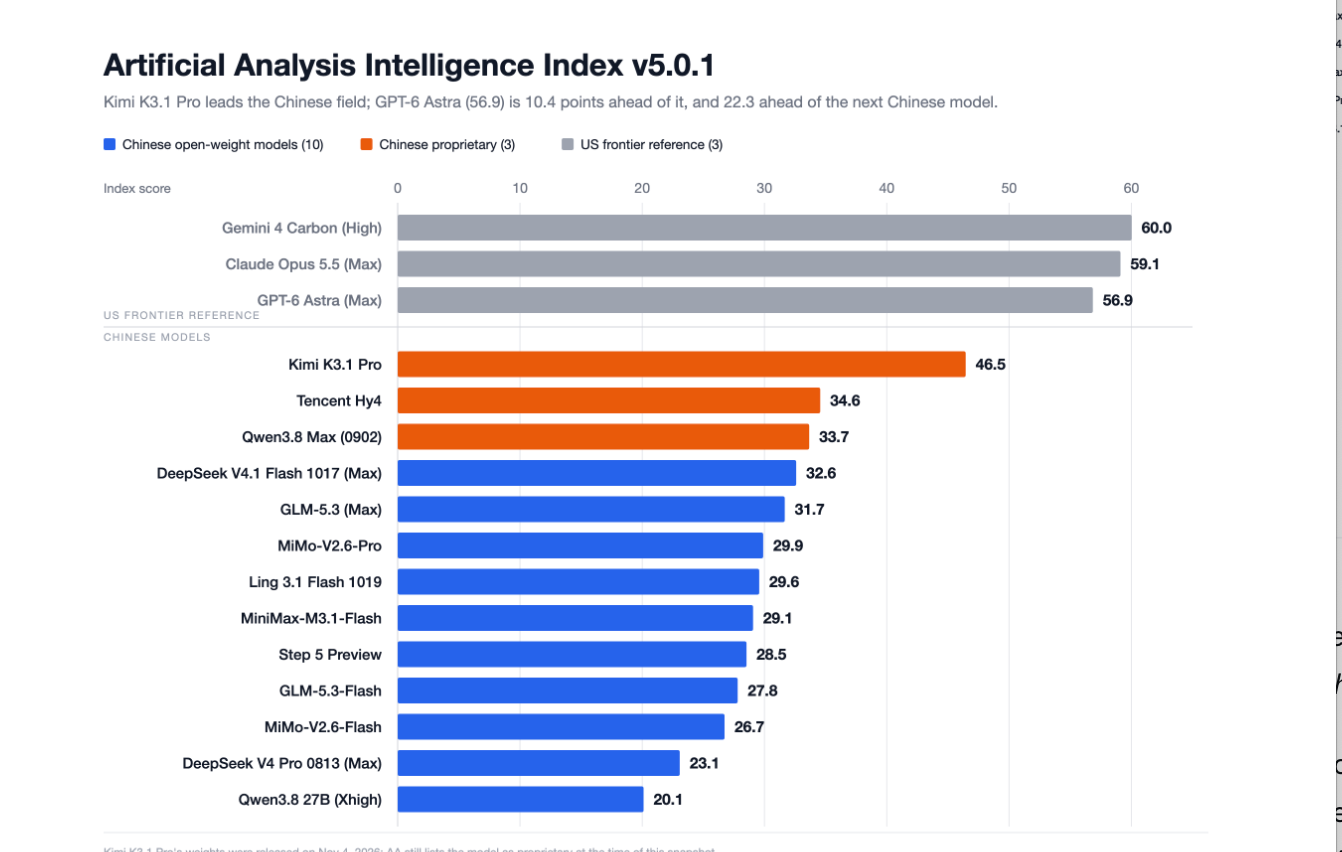
Source: Artificial Analysis Intelligence Index v5.0.1, retrieved November 5, 2026. Kimi's weights were released on November 4; AA scored the API version before that, so its leaderboard still lists the model as proprietary.
The Chinese field is not a smooth gradient. Kimi K3.1 Pro is 12 points clear of the next Chinese model. Then four labs land within about three points of each other — Tencent Hy4 (34.6), Qwen3.8 Max (33.7), DeepSeek V4.1 Flash (32.6), and GLM-5.3 (31.7). Another cluster sits in the high 20s. Practically, that means "which Chinese model is best" depends almost entirely on which of the nine evaluations resembles your workload.
The gap to the US frontier is real. Gemini 4 Carbon (High) scores 60.0, Claude Opus 5.5 (Max) 59.1, GPT-6 Astra (Max) 56.9. Kimi is 13.6 points behind the leader. Anyone claiming parity on the headline composite is rounding away something that matters.
But look at what happens when openness is part of the comparison:
- Nine of the top ten open-weight models on AA are Chinese. The only non-Chinese entry is Mistral Large 4 (High) at 26.1.
- Counting AA's open-weights table, 14 of the top 20 are Chinese.
- The best Chinese open-weight model, DeepSeek V4.1 Flash (32.6), beats the best US open-weight model, Meta's Muse Spark Open (24.9), by 7.7 points.
If your plan for 2026 involves downloading weights and running them yourself, the shortlist writes itself: the strongest open-weight Chinese models sit above every non-Chinese one. That is the genuine reversal of the last two years, more than any single benchmark score.
The gap also isn't uniform across domains. Artificial Analysis publishes six separate capability indices — finance, strategy, legal, healthcare, engineering, economics — and Kimi K3.1 Pro is competitive with the US frontier on some of them and not on others.
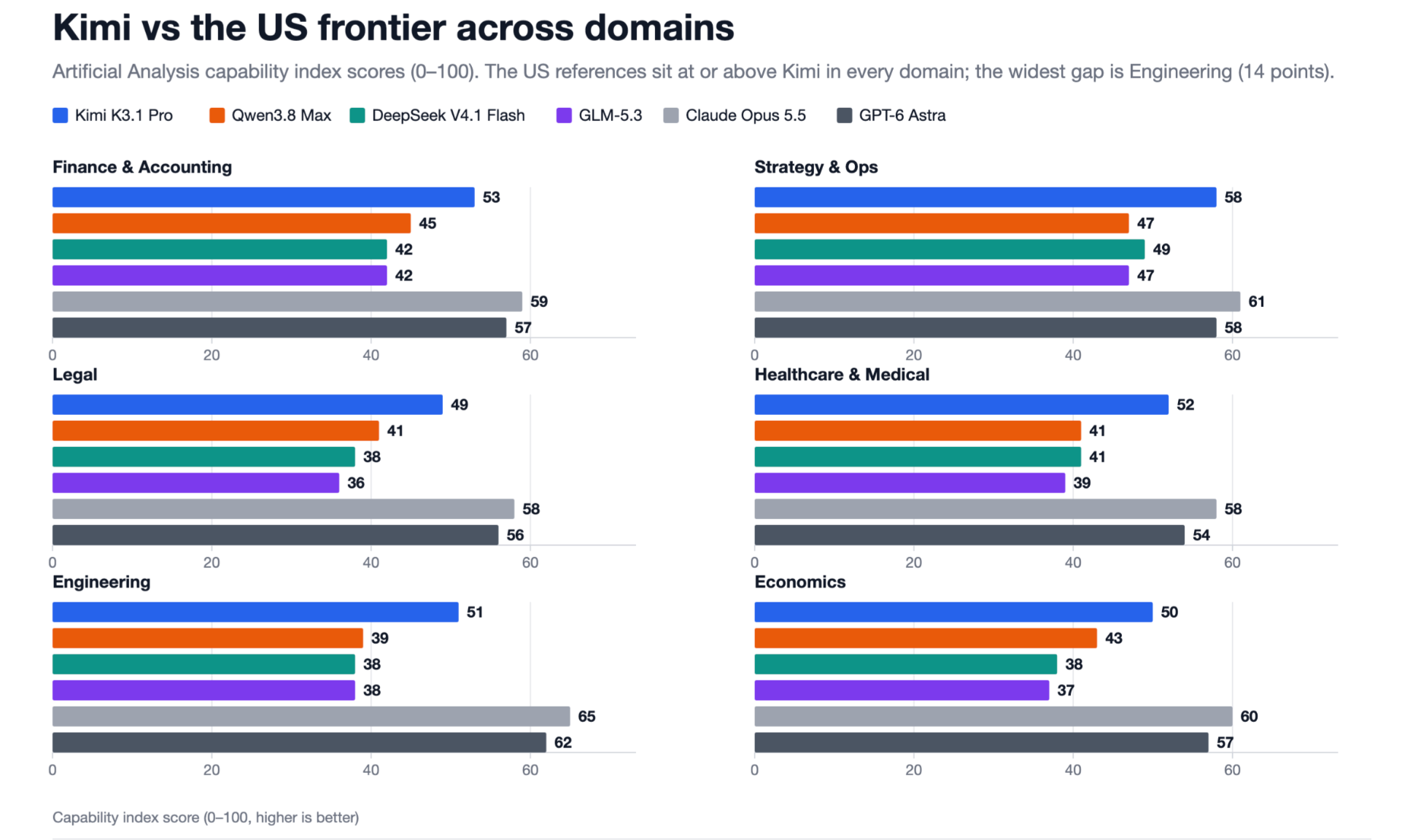
Source: Artificial Analysis Capability Index comparison, AA homepage, retrieved November 5, 2026.
Kimi matches GPT-6 Astra on strategy and operations and trails Claude Opus 5.5 by nine points on legal. Engineering is the widest gap: 51 versus 65. If your workload is closer to "read contracts and produce a memo" than "design a bridge," the 13.6-point headline gap overstates the practical distance. If it's the other way around, it probably understates it.
The models, one by one
I'm not going to pretend every one deserves equal space. Kimi, DeepSeek, Qwen, and GLM are the four I'd shortlist. The rest are specialist tools, regional plays, or bets worth watching.
Kimi K3.1 Pro (Moonshot AI)
Moonshot released Kimi K3.1 Pro on October 24, 2026. It's a 2.8-trillion-parameter MoE with 104B active parameters — per the released model card as reported; the card itself wasn't reachable from here — with a 1,048,576-token context window and native image and video input. Reasoning is always on, with effort levels low, high, or max; the default is max. On AA it scores 46.5 — first in China, 23rd in the world. The sub-scores explain why people are paying attention. It posts 1674.8 Elo on AA-Briefcase (agentic knowledge work), 73.3% on AutomationBench-AA, 86.3% on the long-context reasoning eval, and 67.2% on Terminal-Bench 4.0. That last number is the highest AA has recorded on that evaluation — above Gemini 4 Carbon (65.2%) and Claude Opus 5.5 (59.6%). Moonshot's own harness tells a slightly different story, with K3.1 Pro at 65.7% behind Opus's 66.4%, which is a good reminder that the harness matters as much as the model.
The catch is price and license. Kimi's API is $2.00 input / $10.00 output per 1M tokens with $0.20 cached input — literally frontier-model pricing — and AA's cost-per-task figure of $3.68 is inflated by verbosity: AA's model page notes the model generated 110M output tokens during its index runs, against a median of 64M. That verbosity, not the per-token price, is what makes the task-level cost look high. Cheaper isn't coming.
Then there's the license, which is genuinely complicated. Moonshot promised full weights by November 4, and on November 4 the weights were published on Hugging Face. But it's a custom, non-OSI license, not MIT or Apache. Reported terms include a revenue gate for model-as-a-service providers and an attribution requirement for very large products. I couldn't load the model card directly — Hugging Face isn't reachable from this environment — so treat the specific thresholds as reported rather than confirmed, and read the license file yourself before you build a product on it. AA still scores the model as proprietary: it evaluated the API version before the weights dropped.
Access: https://api.moonshot.ai/v1, OpenAI-compatible (also Responses and Anthropic-compatible APIs). Model IDs kimi-k3.1-pro and kimi-k3.1-pro-highspeed. Kimi offers zero data retention for API customers, which is worth knowing if that's a procurement blocker for you.
DeepSeek V4.1 Flash
DeepSeek's current workhorse is V4.1 Flash, released September 10, 2026, with a new snapshot (1017) on October 17. It's a 552B-parameter MoE with a new causal encoder–decoder architecture that activates just 8B parameters for input and 16B for output, and it keeps KV cache to 890 bytes per token — roughly a quarter of the previous generation's HBM footprint, per DeepSeek. Context is 1M, max output 384K.
At 32.6 on AA, it tops AA's open-weights leaderboard. Kimi would sit above it if AA reclassified Kimi after the weight release, but as scored, DeepSeek leads the open-weight field. At $0.30 input / $1.20 output per 1M tokens — and half that during off-peak hours — it's also one of the cheapest ways to get that level of capability from an API. Cache hits cost $0.006 per 1M input tokens at peak, $0.003 off-peak. Weights are MIT, on Hugging Face and ModelScope.
The peak/off-peak detail deserves its own paragraph because it's unusually relevant to US teams. DeepSeek's peak hours are 01:00–04:00 and 06:00–10:00 UTC, Monday through Friday. Those windows are 8–11pm and 1–5am US Eastern. In other words, the entire US workday is DeepSeek's off-peak, which means the effective price for a US team calling during business hours is $0.15 / $0.60 per 1M tokens, not the list price. That's a real discount most cost comparisons miss.
The older V4 Pro (1.6T total / 49B active, August 2026) is still served at $1.32 / $3.96, but it now scores lower than Flash on AA (23.1). Unless you have a specific reason to use it, Flash is the model to take.
Access: https://api.deepseek.com (OpenAI format) or https://api.deepseek.com/anthropic. Model IDs deepseek-flash and deepseek-v4-pro.
Qwen3.8 Max and the Qwen open family (Alibaba)
Alibaba's Qwen is the most "enterprise-shaped" Chinese lab, and Qwen3.8 Max is its flagship. Released August 3, 2026, with a 0902 snapshot on September 2, it's a 2.4T-parameter MoE with 95B active, a 1M context window (983,616 max input in thinking mode, 131,072 max output), image/video input, and reasoning effort levels. On AA it scores 33.7 with a cost per task of $10.02 — within two cents of Claude Opus 5.5's $10.04. That's the sharpest value contrast in this entire dataset: Qwen is 1.1 index points behind DeepSeek V4.1 Flash and roughly 16.6× more expensive per task.
What you're paying for isn't the benchmark score. It's the ecosystem. Qwen has open-weight siblings at almost every size: a 2.4T/95B model under a custom Qwen3.8-Max license, a 27B dense model under Apache-2.0, a Flash model at $0.15 / $0.47, and a Coder model. It has OpenAI- and Anthropic-compatible endpoints, and Alibaba Cloud's Model Studio lists a US (Virginia) region — one of the few Chinese providers that lists a US region at all. For a team that wants one vendor for hosted frontier, cheap hosted, and self-hosted variants, Qwen is the least friction.
The license nuance matters: the big Qwen3.8 open-weight model is not Apache-2.0. It carries a custom "Qwen3.8-Max License." The 27B model and Qwen3 Coder Next are Apache-2.0.
Access: https://dashscope-intl.aliyuncs.com/compatible-mode/v1 for the international OpenAI-compatible endpoint; Anthropic-compatible at .../apps/anthropic. Model IDs qwen3.8-max, qwen3.8-27b, qwen3.8-flash.
GLM-5.3 and GLM-5.3-Flash (Z.ai)
Z.ai's GLM-5.3 was released August 14, 2026, with weights following on August 28 under — again — a custom license, the "GLM-5.3 License." It's text-only, 1M context, 128K max output, thinking always enabled with low/high/max effort. Official pricing is $1.40 input / $4.40 output per 1M tokens, with cached input at $0.26. On AA it scores 31.7 at $5.01 per task.
The reason to care about GLM-5.3 is terminal work. It's the highest-ranked Chinese model on the official Terminal-Bench leaderboard at 41.8% (#9 overall), with GLM-5.3-Flash next at 35.8% (#12). The overall leader on that board is Claude Opus 5.5 (Max) at 64.8%. Z.ai's own numbers claim 88.2 on Terminal-Bench 2.1 and 66.9 on DeepSWE v1.1, which are vendor-run and not comparable to the AA scores, but they're directionally consistent with the official board: this is a model built for an agent that has to run commands and fix its own mistakes.
GLM-5.3-Flash is the more interesting deal for most people. Released August 26, it's a 320B/18B-active MoE with native multimodal input, 1M context, and pricing of $0.15 / $0.50 per 1M tokens. On AA it scores 27.8 for $0.58 per task — one of the best capability-per-dollar points in the dataset. A previous generation, GLM-5.2, is MIT licensed, which makes it the fallback if you want a permissive GLM for self-hosting.
Access: https://api.z.ai/api/paas/v4/, OpenAI-compatible. Model IDs glm-5.3 and glm-5.3-flash.
Tencent Hy4
Tencent released Hunyuan Hy4 on November 4, 2026, and it's the second-best Chinese model on AA (34.6) — ahead of Qwen and DeepSeek, behind only Kimi. Tencent's cloud docs list it at 770B total parameters with 49B active and ~1M context, and it adds something the others don't: vision and computer use, meaning it can operate a GUI as well as a terminal. Tencent's list price is ¥6 input / ¥18 output / ¥0.3 cached per 1M tokens, with a 50% discount through December 31, 2026; the international TokenHub USD price is $0.834 / $2.501 with $0.042 cached.
First, Hy4 is not open weights yet. Tencent's release says the weights will be open-sourced "soon" and a system card published; as of November 5 it's proprietary. Don't plan a self-hosted deployment around it. Second, AA's omniscience data is odd: 49.97% accuracy but only a 10.93% non-hallucination rate. Tencent claims its own hallucination rate improved from 12.95% to 7.2% in the final version, but whatever the truth is, Hy4 is a model to verify before trusting in a high-stakes knowledge task. The computer-use capability is genuinely unusual for a Chinese model, and worth testing if that is your use case.
Access: Tencent Cloud TokenHub, OpenAI-compatible. Model ID hy4.
MiniMax-M3.1-Flash
MiniMax released M3.1-Flash on October 19, 2026, open-weighted it on October 23, and priced it at $0.15 / $0.60 per 1M tokens with $0.015 cached input. It has a 1M context window and, unusually, thinking that cannot be disabled — sending thinking: disabled returns a 400 error. On AA it scores 29.1 for $0.49 per task. Its AutomationBench-AA score (72.5%) is the highest of any Chinese model except Kimi, which is notable for a model at this price point. MiniMax's own claims — 73.7% on DeepSWE v1.1, 61.7 on OSWorld V2, 29.6 on Agents' Last Exam — position it as a cheap agentic worker rather than a general assistant.
The licensing is the catch. MiniMax ships under a "MiniMax Community License," which grants non-commercial use and requires a prominent "Built with MiniMax M3.1" attribution for commercial use, with further terms for larger deployments. Read it before you put it in a paid product. The bigger M3 model is also open-weight, with a 1M context (512K guaranteed) and tiered pricing at $0.30 / $1.20 up to 512K input tokens.
Access: https://api.minimax.io/v1 (OpenAI-compatible) or https://api.minimax.io/anthropic. Model IDs MiniMax-M3.1-Flash and MiniMax-M3.
Xiaomi MiMo-V2.6 Pro and Flash
Xiaomi's MiMo models are the least famous and, for high-volume work, the most interesting. Released September 22, 2026, the pair is open-weight under MIT, takes 1M tokens of context and produces up to 128K tokens, and is priced aggressively: MiMo-V2.6-Pro at $0.435 / $0.87 per 1M tokens, MiMo-V2.6-Flash at $0.14 / $0.28. On AA, Pro scores 29.9 for $0.26 per task; Flash scores 26.7 for $0.13 per task — the lowest cost per Index task of any Chinese model on AA's board.
That is the cheapest "actually useful" model I found in this exercise. It is not going to beat Kimi on a hard reasoning task. It will happily do classification, extraction, routing, summarization, and well-specified coding tasks at a price where you stop counting tokens. Xiaomi's own AA claim of 46 is for the Pro and comes from the older v4.x index — under v5.0.1 the Pro scores 29.9 and the Flash 26.7 — so ignore the vendor headline and use the current numbers.
Access: https://api.xiaomimimo.com/v1, OpenAI- and Anthropic-compatible. Model IDs mimo-v2.6-pro, mimo-v2.6-flash.
StepFun Step 5 Preview
StepFun's Step 5 Preview shipped September 20, 2026, with weights on October 15. It's a 600B/27B MoE with 1M context, 64K max output, and pricing at $1.00 / $2.70 per 1M tokens ($0.10 cached). It scores 28.5 on AA for $2.35 per task. The license is a custom "StepFun Model License 1.0" — Apache-2.0-style with extra attribution and commercial conditions, not a standard OSI license.
StepFun's pitch is finance: its official benchmark table claims 67.7 on DeepSWE v1.1 and 85.0 on Terminal-Bench 2.1, and the company talks up long-horizon finance tasks. It also has the most explicit international story of the smaller labs: a separate platform.stepfun.ai with USD pricing and English docs, alongside the Chinese platform.
Access: https://platform.stepfun.ai (international) or https://api.stepfun.com/v1 (China). Model ID step-5-preview.
InclusionAI Ling 3.1 Flash (Ant Group) and LongCat 2.0 (Meituan)
There are two more open-weight labs worth knowing.
Ant Group's InclusionAI released Ling-3.1-flash on September 30 and open-sourced it on October 15 under MIT. It's 560B total / 25B active with a 1M context window, priced at $0.30 / $0.90 per 1M ($0.06 cached), and the 1019 refresh scores 29.6 on AA for $3.19 per task. Its strengths are long-context reasoning (82.3% on AA-LCR) and document-heavy agent work (1522 Elo on AA-Briefcase). Ant also publishes Ring-2.6-1T, a 1T-parameter MIT-licensed model at 256K context for $0.30 / $2.50; it doesn't have a v5.0.1 score yet.
Meituan's LongCat 2.0, released June 30 and open-sourced July 6, is a 1.6T/48B MoE with 1M context and MIT weights. List pricing is $0.75 / $2.95 per 1M with a promotional $0.30 / $1.20. It has no AA v5.0.1 score, and LongCat 2.5 (November 1) is API-only with no weights announced. Interesting engineering, not yet a default choice.
ByteDance and Baidu
ByteDance's Doubao-Seed-2.1-Pro (June 23, updated September 15) is the company's flagship model, with a 1,024K context window and 256K max output. But it's closed, priced in RMB only (¥6 / ¥30 per 1M), served from a Beijing endpoint, and it has no AA score at all. ByteDance's Doubao-Seed-Code is more relevant to developers outside China: 256K context, ¥1.2 / ¥8, and an Anthropic-compatible endpoint designed as a Claude Code drop-in. If you're already operating in China, both make sense. If not, the friction is real.
Baidu is in a similar position. ERNIE 5.0 is a 2.4-trillion-parameter native omni-modal model with 128K context, available internationally on Baidu's Qianfan cloud at $1.4 / $5.6 per 1M tokens — but it's closed and has no AA composite score. The more useful Baidu artifact for developers is ERNIE 4.5 300B A47B: Apache-2.0 weights, 128K context, 300B total / 47B active. Its legacy AA sub-scores are weak by 2026 standards, but an Apache-2.0 model of that size is a legitimate self-hosting option if you need one. Baidu's own blog also lists an ERNIE 5.5 Flash Base release dated today; I haven't evaluated it.
What it actually costs to run them
The most misleading assumption in this category is that Chinese models are cheap. Some are. The flagships are not.
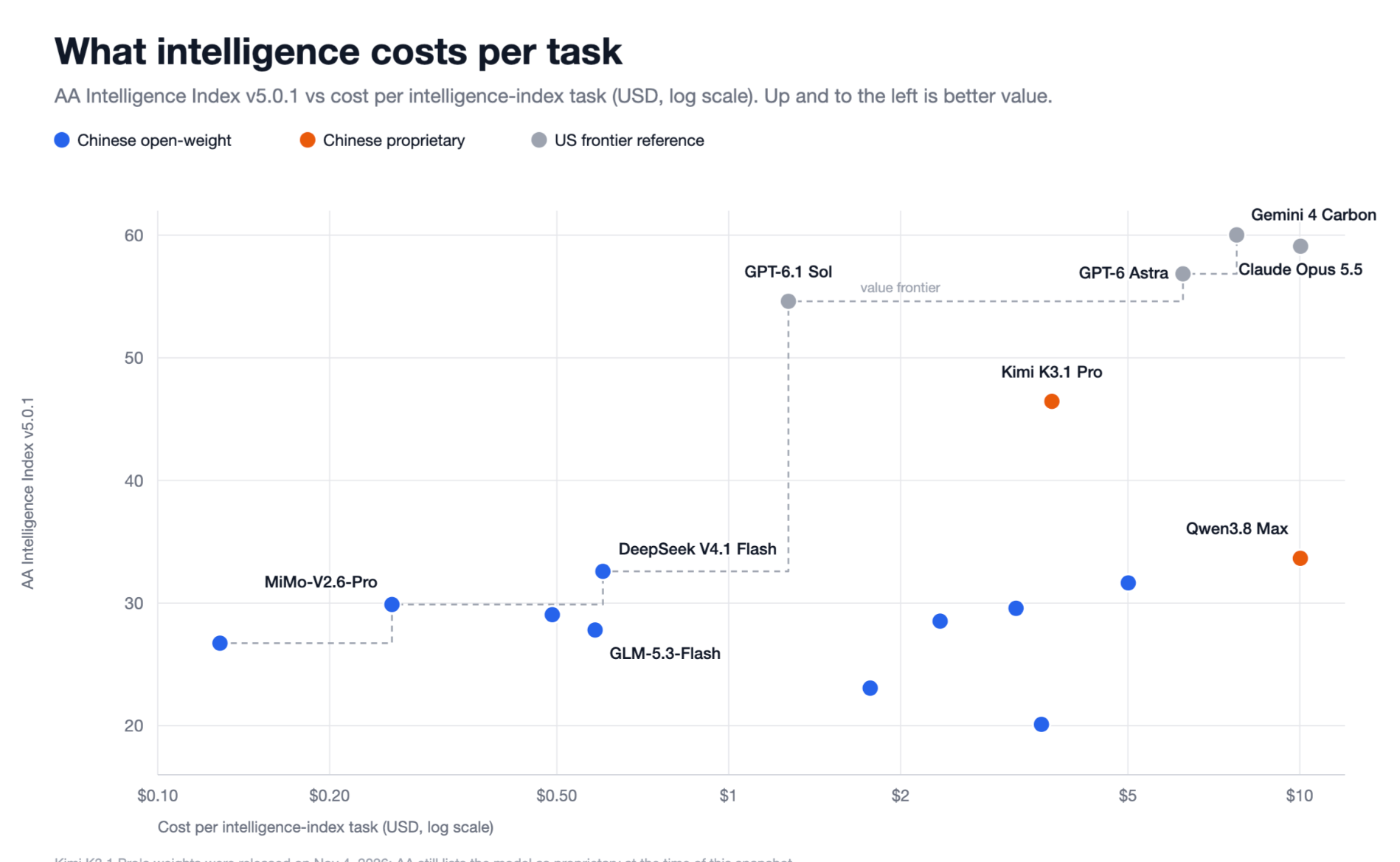
Source: Artificial Analysis, cost per Intelligence Index task, retrieved November 5, 2026. Lower-left is better value.
On AA's cost-per-task metric the spread among Chinese models is roughly 78×, from MiMo-V2.6-Flash at $0.13 to Qwen3.8 Max at $10.02. The pattern is consistent:
Model | AA index | Cost per AA task | List price (in / out, per 1M) |
|---|---|---|---|
Xiaomi MiMo-V2.6-Flash | 26.7 | $0.13 | $0.14 / $0.28 |
Xiaomi MiMo-V2.6-Pro | 29.9 | $0.26 | $0.435 / $0.87 |
MiniMax-M3.1-Flash | 29.1 | $0.49 | $0.15 / $0.60 |
GLM-5.3-Flash | 27.8 | $0.58 | $0.15 / $0.50 |
DeepSeek V4.1 Flash (Max) | 32.6 | $0.60 | $0.30 / $1.20 |
Step 5 Preview | 28.5 | $2.35 | $1.00 / $2.70 |
Ling 3.1 Flash 1019 | 29.6 | $3.19 | $0.30 / $0.90 |
Kimi K3.1 Pro | 46.5 | $3.68 | $2.00 / $10.00 |
GLM-5.3 (Max) | 31.7 | $5.01 | $1.40 / $4.40 |
Qwen3.8 Max (0902) | 33.7 | $10.02 | $2.00 / $6.00 |
The sharpest contrast in that table: DeepSeek V4.1 Flash scores 32.6 for $0.60 per task. Qwen3.8 Max scores 33.7 for $10.02. You are paying 16.6× more for 1.1 index points. That doesn't make Qwen a bad deal — you're buying ecosystem, vision, and enterprise support — but it does mean the "cheap Chinese model" instinct will steer you wrong at the top of the market.
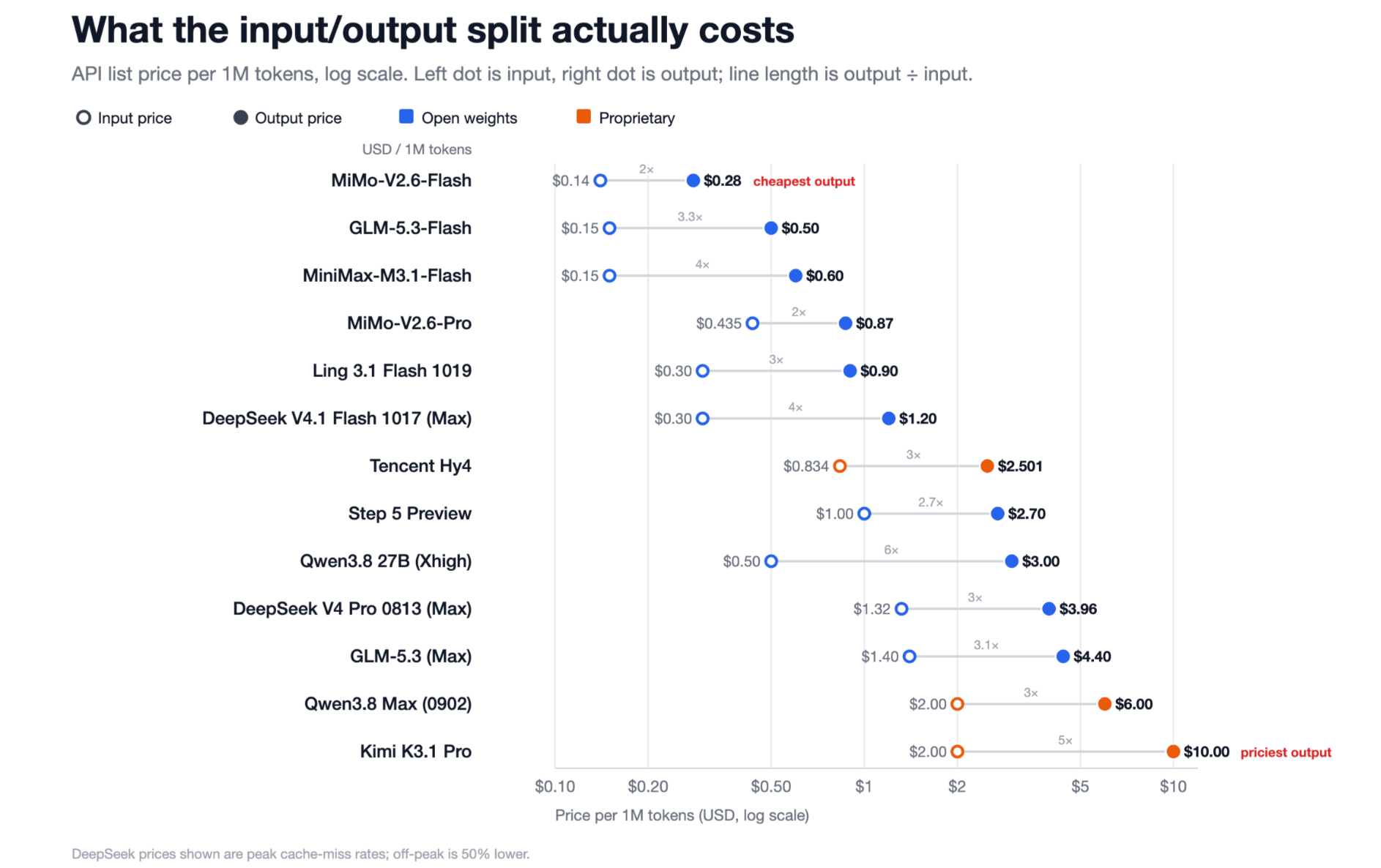
Source: Artificial Analysis API pricing for the 13 indexed Chinese models (a mirror of vendor list prices), retrieved November 5, 2026. DeepSeek prices are peak cache-miss rates; off-peak is 50% lower.
Output tokens cost roughly two to six times input across the board, which means your cost model depends heavily on how verbose the model is — not just on the headline price. That's also why AA's cost-per-task number can diverge sharply from list price: Kimi's $2/$10 looks mid-market, but it still comes out as the third-most-expensive Chinese model per task in this table, thanks to output volume. If you're building an agent that writes a lot, the output price is the price.
Caching is where the real savings live. DeepSeek's cache-hit input is $0.006 per 1M tokens; MiMo-V2.6-Flash's is $0.0028; Qwen3.8 Max's is $0.25. For RAG pipelines or long system prompts with high prefix reuse, a model with a 90% cache discount can beat a cheaper model without one. Kimi's cache discount is 90%, DeepSeek advertises $0.006 against a $0.30 list input — that's 98% — and most Chinese providers now price cached input at 10–20% of fresh input.
And check the promotion. Tencent's Hy4 is 50% off through December 31, 2026. Ling 3.1 Flash is running a limited-time 75% discount on OpenRouter. LongCat 2.0's promotional price is less than half its list price. "Chinese LLM API pricing" in a blog post is a snapshot of a promo calendar as much as a rate card.
Coding and agentic work
For agentic coding, the composite index is too coarse. The most useful boards here don't fully agree.
On the official Terminal-Bench leaderboard, three Chinese models had verified entries as of November 5: GLM-5.3 (Max) at 41.8% (#9), GLM-5.3-Flash at 35.8% (#12), and Qwen3.8-Max-0902 at 27.0% (#13). Claude Opus 5.5 (Max) leads at 64.8%. Those are large gaps. They are also the kind of gap you would expect if the models are strong at well-specified coding tasks and weaker at long-horizon debugging, where the agent has to notice it has gone wrong.
On AA's own coding evaluations the picture shifts. DeepSeek V4.1 Flash is the highest-scoring open-weight model on FrontierCode 2.0 at 28%, which AA's v5 write-up notes is 18 points behind the leader. Kimi K3.1 Pro scores 25.5%. Tencent Hy4, interestingly, scores 31.5% — the best Chinese result on that eval — despite being proprietary. On Terminal-Bench 4.0 within AA's harness, Kimi is far ahead of the Chinese field at 67.2%, followed by GLM-5.3 (41.9%), Qwen3.8 Max (38.9%), Hy4 (37.4%), MiMo-V2.6-Pro (34.8%), and DeepSeek (33.8%).
Here's the wrinkle worth sitting with: on AA's Terminal-Bench 4.0 run, Kimi's 67.2% is the best score of any model in the dataset, ahead of Gemini 4 Carbon (65.2%) and Claude Opus 5.5 (59.6%). On the official tbench.ai leaderboard, Kimi doesn't appear at all, and the top Chinese entry is GLM-5.3 at 41.8% against Opus's 64.8%. Same benchmark family, different harness, different answer. That isn't a scandal — it is what happens when "the leaderboard" is really several leaderboards. Treat every single-benchmark claim, including mine, as one data point.
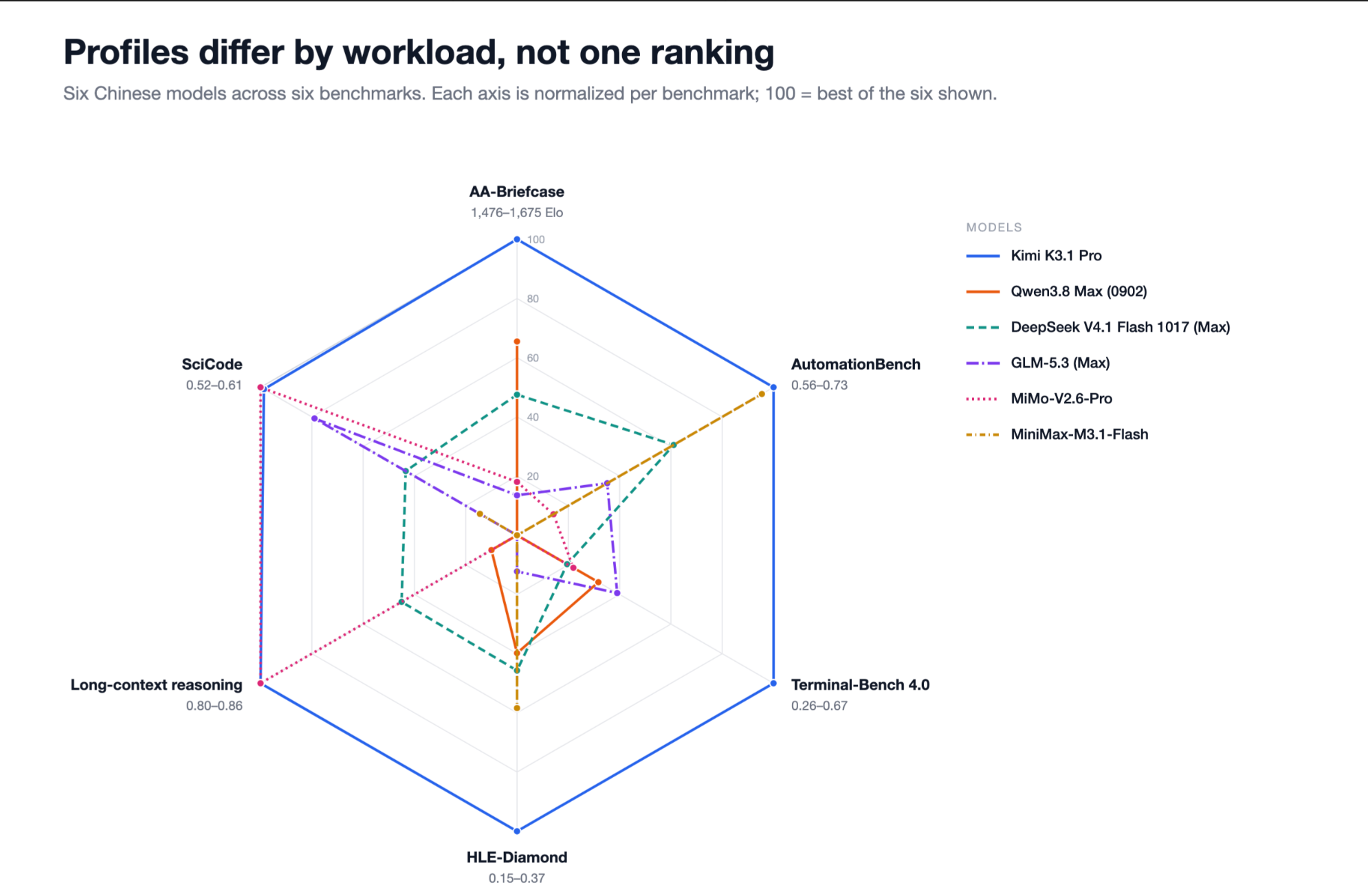
Source: Artificial Analysis Intelligence Index v5.0.1 sub-scores, retrieved November 5, 2026. Normalized per benchmark; 100 = best of the six models shown.
The radar is the useful part: these are not scaled-down versions of one model. Kimi is the largest shape on almost every axis, which is what a 12-point lead looks like. Below it, the profiles diverge: MiniMax-M3.1-Flash and DeepSeek V4.1 Flash hold up better on automation than on hard reasoning, MiMo-V2.6-Pro matches Kimi on long-context reasoning (86.3% on AA-LCR) and SciCode but has the weakest HLE-Diamond score in the group (15.2%), and GLM-5.3 is the most uneven of the six. Picking on the composite alone throws that away.
One caveat about the official Terminal-Bench board: its page version label was garbled when I read it, so I can't tell you whether it's Terminal-Bench 2.0 or 4.0. Treat those scores as a relative signal, not something you can compare to AA's Terminal-Bench 4.0 numbers.
Context windows, licenses, and self-hosting
Context window has become table stakes. Most flagships in this post claim roughly a million tokens; the exceptions are Baidu's ERNIE (128K) and the native windows of Qwen's smaller open models (256K–262K, though they extend to 1M with YaRN). What differs is the usable portion, the max output, and the license.
Model | Weights | License | Context | Max output | AA v5.0.1 |
|---|---|---|---|---|---|
Kimi K3.1 Pro | Released Nov 4 | Custom (non-OSI) | 1,048,576 | 131K default / 1M max | 46.5 |
DeepSeek V4.1 Flash | Open | MIT | 1M | 384K | 32.6 |
DeepSeek V4 Pro | Open | MIT | 1M | 384K | 23.1 |
Qwen3.8 Max | Closed | — | 1M (991,808 in) | 131K | 33.7 |
Qwen3.8 2.4T A95B | Open | Custom Qwen3.8-Max | 262K native / 1.01M YaRN | — | not scored |
Qwen3.8 27B | Open | Apache-2.0 | 262K native / 1M YaRN | — | 20.1 |
GLM-5.3 | Open | Custom GLM-5.3 | 1M | 128K | 31.7 |
GLM-5.3-Flash | Open | Custom (GLM family; unverified) | 1M | — | 27.8 |
Tencent Hy4 | Closed (weights promised) | — | ~1M | ~64K | 34.6 |
MiniMax-M3.1-Flash | Open | MiniMax Community | 1M | — | 29.1 |
MiMo-V2.6-Pro / Flash | Open | MIT | 1M | 128K | 29.9 / 26.7 |
Step 5 Preview | Open | StepFun Model License 1.0 | 1M | 64K | 28.5 |
Ling 3.1 Flash 1019 | Open | MIT | 1,048,576 | — | 29.6 |
LongCat 2.0 | Open | MIT | 1,048,576 | 128K | not scored |
ERNIE 4.5 300B A47B | Open | Apache-2.0 | 131,072 | — | not scored |
Dashes mean the vendor page I could read didn't state the figure, not that it's zero.
License notes, because this is where teams get burned:
- Open weights is not open source. MiniMax's community license grants non-commercial use and requires attribution for commercial use. GLM-5.3 uses a custom license with a security-review clause for very large model-as-a-service providers. Kimi's license has commercial conditions. None of these are OSI-approved.
- MIT and Apache-2.0 exist and are worth preferring when you can. DeepSeek's V4.1 Flash and V4 Pro are MIT. Xiaomi's MiMo models are MIT. Ant's Ling models are MIT. Meituan's LongCat 2.0 is MIT. Qwen's 27B and Coder models are Apache-2.0, as is ERNIE 4.5. If you need legal simplicity, that's your shortlist.
- The big Qwen open model is not Apache-2.0. This is a common mistake. The 2.4T open-weight Qwen uses a custom "Qwen3.8-Max License"; only the smaller Qwen models are Apache-2.0.
Calling them from the US
Most major Chinese providers now offer OpenAI-compatible endpoints that bill in USD. That's made the switch from a US model mostly a matter of changing a base URL and a model ID — with caveats around region, data retention, and currency.
Provider | Base URL | Compatibility | Notes |
|---|---|---|---|
DeepSeek | OpenAI, Anthropic | Off-peak discount aligns with US hours | |
Moonshot | OpenAI, Responses, Anthropic | Zero data retention for API customers | |
Alibaba | OpenAI, Anthropic | US (Virginia) region listed; USD billing | |
Z.ai | OpenAI | USD billing | |
Tencent | Tencent Cloud TokenHub | OpenAI | International USD pricing on TokenHub |
MiniMax | OpenAI, Anthropic | USD billing | |
Xiaomi | OpenAI, Anthropic | USD billing | |
StepFun | OpenAI | Separate international platform | |
LongCat | OpenAI, Anthropic | USD and CNY docs | |
ByteDance | OpenAI, Anthropic (Code) | China endpoint, RMB billing | |
Baidu | Baidu AI Cloud International (Qianfan) | — | USD pricing on international cloud |
The shortest path is the OpenAI SDK with a different base URL:
from openai import OpenAI

# DeepSeek — off-peak pricing during US business hours
client = OpenAI(base_url="https://api.deepseek.com", api_key="...")
resp = client.chat.completions.create(
    model="deepseek-flash",
    messages=[{"role": "user", "content": "..."}],
)

# Kimi — same interface
kimi = OpenAI(base_url="https://api.moonshot.ai/v1", api_key="...")
resp = kimi.chat.completions.create(
    model="kimi-k3.1-pro",
    messages=[{"role": "user", "content": "..."}],
)
Before you route production traffic, two checks. First, data handling: Kimi advertises zero data retention for API customers; for the others, read the data-processing terms rather than assuming. Second, region: Alibaba's Model Studio lists a US region, but many other Chinese providers serve from China or Singapore, which affects latency and may affect your own compliance obligations. I'm not a lawyer, and this is the part where you should ask yours.
How to choose
A decision list, in order of how often I'd expect a US team to need it:
- High-volume extraction, classification, routing. Start with MiMo-V2.6-Flash ($0.14/$0.28) or MiniMax-M3.1-Flash ($0.15/$0.60). At these prices you can be generous with context and retries.
- A coding agent that runs commands. GLM-5.3 is the best-evidenced choice on the official Terminal-Bench board. If you want open weights and lower cost, DeepSeek V4.1 Flash.
- The hardest reasoning tasks, price secondary. Kimi K3.1 Pro. It's the only Chinese model within 14 points of the US frontier, and it's the best Chinese model on agentic knowledge work.
- A general enterprise API with a US region. Qwen3.8 Max. You'll pay frontier prices per task, but you get the most mature tooling and the widest model family.
- Self-hosting on your own GPUs. Qwen3.8 27B (Apache-2.0), DeepSeek V4.1 Flash (MIT), or ERNIE 4.5 300B A47B (Apache-2.0) for larger deployments. GLM-5.2 (MIT, 1M context) is the permissive fallback from the GLM line.
- Long documents and RAG. Kimi K3.1 Pro, DeepSeek V4.1 Flash, Ling 3.1 Flash, or GLM-5.3, all with ~1M context and cache discounts.
- Computer-use agents. Hy4 is the one with GUI control, but verify its factual reliability before you trust it. Kimi's agentic scores are the safer general bet.
- You need frontier-adjacent capability, not necessarily Chinese. Don't force it. Gemini 4 Carbon and Claude Opus 5.5 are still ahead on the composite. The Chinese advantage is in open weights and mid-market price.
How fast this field moves
One more chart, because it explains why any "best Chinese AI models" list has a short shelf life.
Source: official vendor announcements, compiled November 5, 2026.
The chart tracks 24 dated releases across nine labs. Three more labs — ByteDance, LongCat, and InclusionAI — each shipped one notable model in the same window and I left them off to keep the chart readable, which brings the real count to 27 releases from 12 labs in about 16 months. DeepSeek alone shipped five. Alibaba, Moonshot, and Z.ai each shipped three or more. The densest stretch is August through November 2026, exactly the period in which the open-weight lead changed hands several times. This is not a market where you pick a model once and revisit in a year.
What benchmarks still don't tell you
Before you commit a production workload, two things.
Token efficiency is not in the index. AA's own model page notes that Kimi generated 110M output tokens while running the Intelligence Index, against a median of 64M. That is why its cost per task is high even though its per-token price is mid-range. The same trap applies in reverse: a cheap model that rambles can cost more at the task level than an expensive model that writes tightly.
Context windows aren't usable context. The models here that claim roughly 1M tokens score between 74% and 88% on AA's long-context reasoning evaluation. Test retrieval at your real document length, not the marketed maximum.
FAQ
Are Chinese AI models available to US developers?
For most major providers, yes. DeepSeek, Moonshot, Alibaba Cloud, Z.ai, MiniMax, Xiaomi, StepFun, and LongCat all publish international endpoints with USD billing and English documentation. Alibaba's Model Studio lists a US (Virginia) region; most others serve from China or Singapore. Some models — ByteDance's Doubao, for instance — are RMB-priced and China-endpoint only. Check terms for your jurisdiction before routing user data.
Are Chinese AI models cheaper than GPT or Claude?
It depends entirely on the tier. MiMo-V2.6-Flash at $0.14/$0.28 per 1M tokens is under 2% of GPT-6 Astra's list price. But Kimi K3.1 Pro at $2/$10 and Qwen3.8 Max at $2/$6 cost roughly what Western frontier models cost per task — AA's figures put Kimi at $3.68, Qwen at $10.02, and Claude Opus 5.5 at $10.04. The cheap tier is where the advantage is; the flagship tier is competitively priced, not cheap.
Are these models open source?
Many are open-weight, but only some use OSI-approved licenses. DeepSeek V4.1 Flash and V4 Pro are MIT. Xiaomi's MiMo models, Ant's Ling models, and Meituan's LongCat 2.0 are MIT. Qwen3.8 27B and Qwen3 Coder Next are Apache-2.0, as is ERNIE 4.5. Kimi K3.1 Pro, GLM-5.3, Qwen3.8 2.4T, MiniMax-M3.1-Flash, and Step 5 use custom licenses with commercial conditions.
DeepSeek vs Qwen vs Kimi — which should I pick?
Kimi K3.1 Pro if you need the highest score and can pay flagship prices per task. DeepSeek V4.1 Flash if you want open weights, MIT licensing, and the lowest cost per task of the three. Qwen3.8 Max if you need a US region, mature tooling, or open-weight siblings you can self-host. That is the short answer; the rest of this post is the long one.
Which Chinese model is best for coding?
On independent evidence, GLM-5.3 is the safest choice for terminal-based agents: 41.8% on the official Terminal-Bench board, the highest Chinese entry. DeepSeek V4.1 Flash is the best open-weight model on AA's FrontierCode 2.0 at 28%. Kimi K3.1 Pro is the strongest generalist if cost per task isn't the constraint.
Do Chinese models support OpenAI-compatible APIs?
Most of the major ones do. DeepSeek, Moonshot, Z.ai, MiniMax, Xiaomi, StepFun, and LongCat all document OpenAI-compatible endpoints; Alibaba offers both OpenAI- and Anthropic-compatible modes; ByteDance's Ark platform and Doubao-Seed-Code support Anthropic-compatible endpoints for Claude Code. Switching is usually a base URL plus a model ID change.
How should I benchmark them for my own workload?
Use your own eval set. Pull 50–200 representative tasks, run each candidate blind, and score them on the same rubric while recording cost and latency per task. The public composites are a shortlist generator, not a decision. And test token usage, not just price per 1M tokens — a model that uses twice the output tokens is twice as expensive in practice.
Are there privacy or compliance risks?
There are considerations, and they're not unique to Chinese providers: where the data is processed, whether it's retained, and what the provider's terms allow. Kimi states zero data retention for API customers. For everyone else, read the terms and map them to your own obligations — especially if you handle regulated data. This post is not legal advice.
Sources and data notes
- Artificial Analysis — Intelligence Index v5.0.1 and model evaluations, retrieved November 5, 2026: leaderboard, open-weight leaderboard, Intelligence Index v5 announcement, performance methodology v3.0.0. Where AA rounds scores on its public page, this post uses one decimal from the underlying data.
- Terminal-Bench — official leaderboard, retrieved November 5, 2026: tbench.ai/leaderboard.
- SWE-bench — official leaderboard, retrieved November 5, 2026: swebench.com. Newest Chinese entries are from February 2026.
- Vendor documentation and pricing — DeepSeek API docs, Moonshot platform, Alibaba Cloud Model Studio, Z.ai docs, Tencent Cloud TokenHub, MiniMax platform, Xiaomi MiMo, StepFun platform, LongCat, Baidu Qianfan, ByteDance Volcano Engine.
- Weights and model cards — Hugging Face orgs: deepseek-ai, Qwen, moonshotai, zai-org, MiniMaxAI, XiaomiMiMo, inclusionAI, stepfun-ai, meituan-longcat, baidu. Hugging Face was not directly reachable during this research; license and parameter details from those pages are marked as reported where they could not be verified at the source.
- Excluded — LMArena/Arena and SuperCLUE figures were omitted because the leaderboard pages were not retrievable in this environment; the numbers in circulation for both are press-reported, not primary.
Published November 5, 2026. Prices and scores change; check the linked source pages before making a decision.