

Gemini 4 Models Explained: Hydrogen, Argon, Carbon, and Neon
Google now has four Gemini 4 models. Here’s how they differ, what the API costs, and where you can use each one. Updated November 25, 2026.
What Is Gemini 4?
Gemini 4 is a family of Google models covering everyday coding, agent workflows, and demanding reasoning tasks. As of November 24, 2026, the official lineup includes Hydrogen, Argon, Carbon, and Neon.
Model | API model ID | Google’s stated focus |
|---|---|---|
Hydrogen |
| Everyday coding and efficient agent execution |
Argon |
| Complex reasoning with lower token consumption than Carbon |
Carbon |
| The family’s most demanding reasoning workflows |
Neon |
| Frontier capabilities with fast task completion |
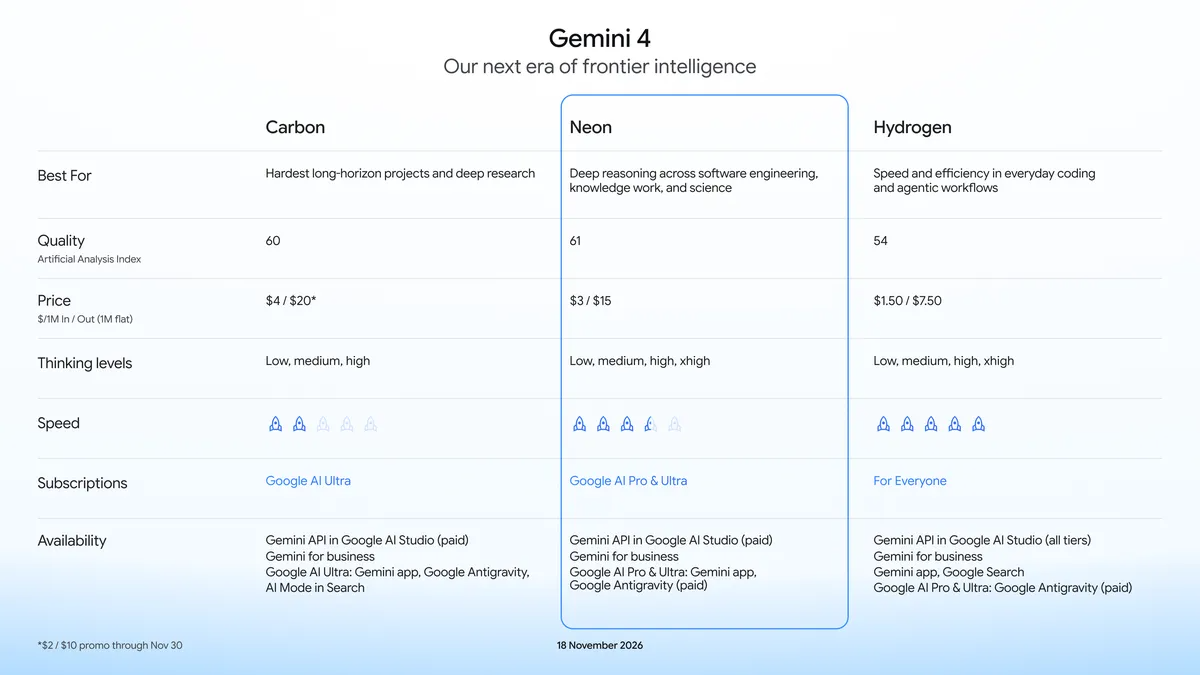
Gemini 4 model lineup. Source: Google’s Gemini 4 Neon announcement.
All four list a 1M-token context window and accept text, images, audio, video, and PDFs. Context size alone therefore gives you little reason to choose one over another. Their intended workloads and token costs are more useful starting points. Google’s model catalog
What each model is for
Hydrogen: everyday coding and agent tasks
Hydrogen is Google’s model for routine development work, including writing code, running tests, and verifying changes. It also fits the worker role in an agent system where another model handles planning.
It supports four thinking levels: low, medium, high, and xhigh. The default is high. Before moving an entire workload to a different model, it is worth checking whether a different thinking setting meets your requirements. Hydrogen announcement
Argon and Carbon: longer, harder problems
Google positions Argon for much of the software engineering and knowledge work that needs deeper reasoning. Carbon targets harder cases, including extended debugging and open-ended scientific research.
There is a billing detail here that is easy to miss. Google says Carbon spends more tokens exploring problems and checking its work. Even when Argon and Carbon have the same price per token, Carbon can produce a larger bill for a task. Carbon availability announcement
Neon: another option for complex work
Neon joined the family on November 18. Google emphasizes fast task completion across software engineering, knowledge work, and science.
That makes it worth considering when a workflow needs substantial reasoning but also has a response-time budget. The launch description does not tell you how quickly it will finish your particular job. Neon announcement
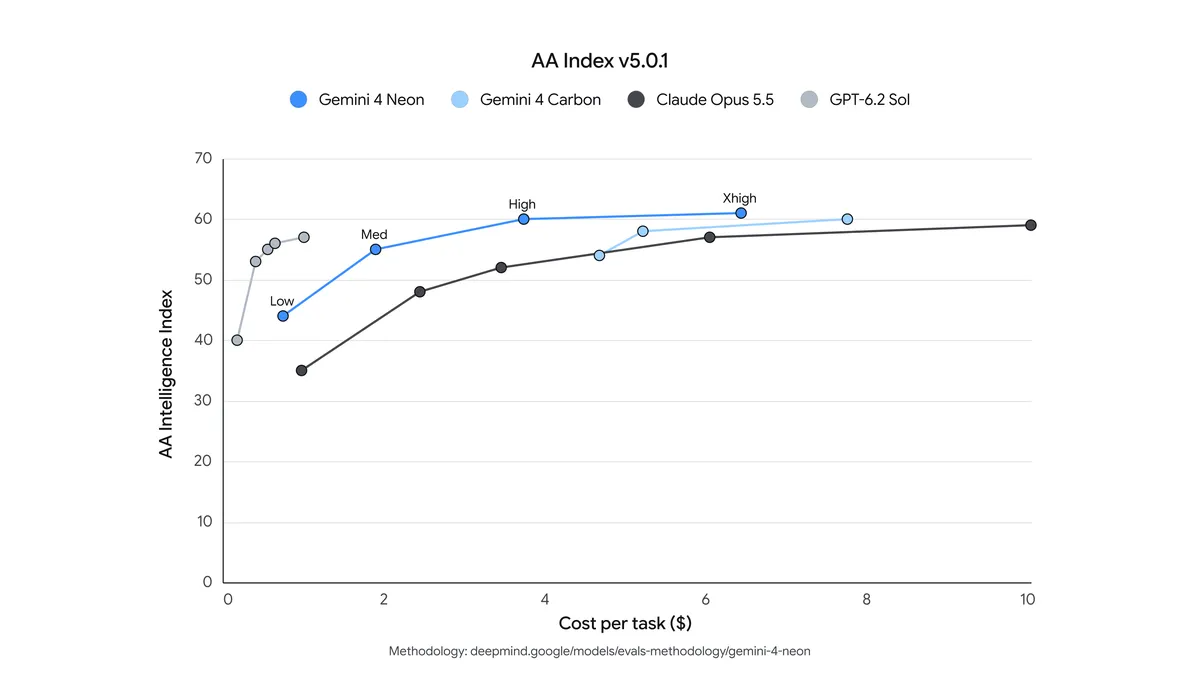
Benchmark performance and cost per task, as reported by Google. Source: Google.
Pricing: watch the December change
Standard API rates are in US dollars per million tokens:
Model | Input | Output |
|---|---|---|
Hydrogen | $1.50 | $7.50 |
Argon | $2.00 | $10.00 |
Carbon | $2.00 | $10.00 |
Neon | $3.00 | $15.00 |
Argon and Carbon’s prices above are introductory rates through November 30, 2026. On December 1, both rise to $4 input and $20 output. Output charges include thinking tokens; caching and tools have their own pricing details. Gemini API pricing
For a simple illustration, 10,000 input tokens and 2,000 billed output tokens cost $0.03 on Hydrogen and $0.06 on Neon, before additional charges. Those figures assume identical token counts. They are useful for understanding the rates, but they do not predict what either model will spend solving a problem.
Where you can use them
If you’re building an app, Google AI Studio is a good place to start. All four models have entry points there, and you can use the Gemini API to integrate them into your project. Just copy the model ID from the model catalog into your API configuration.
Using them in the Gemini app or Google Antigravity takes a little more checking. Availability varies by model and subscription: Google’s Neon announcement covers Pro and Ultra subscribers, while Carbon’s consumer rollout is aimed at Ultra subscribers. Check the product you’re using to see what’s available on your account.
For a new project, I’d try Hydrogen first. It has the lowest listed token prices, which makes it an appealing starting point. For more demanding tasks, I’d also try Argon or Neon. Carbon is worth considering for work that calls for more exploration and checking. That’s my starting shortlist based on Google’s descriptions and pricing; I haven’t tested the models side by side.
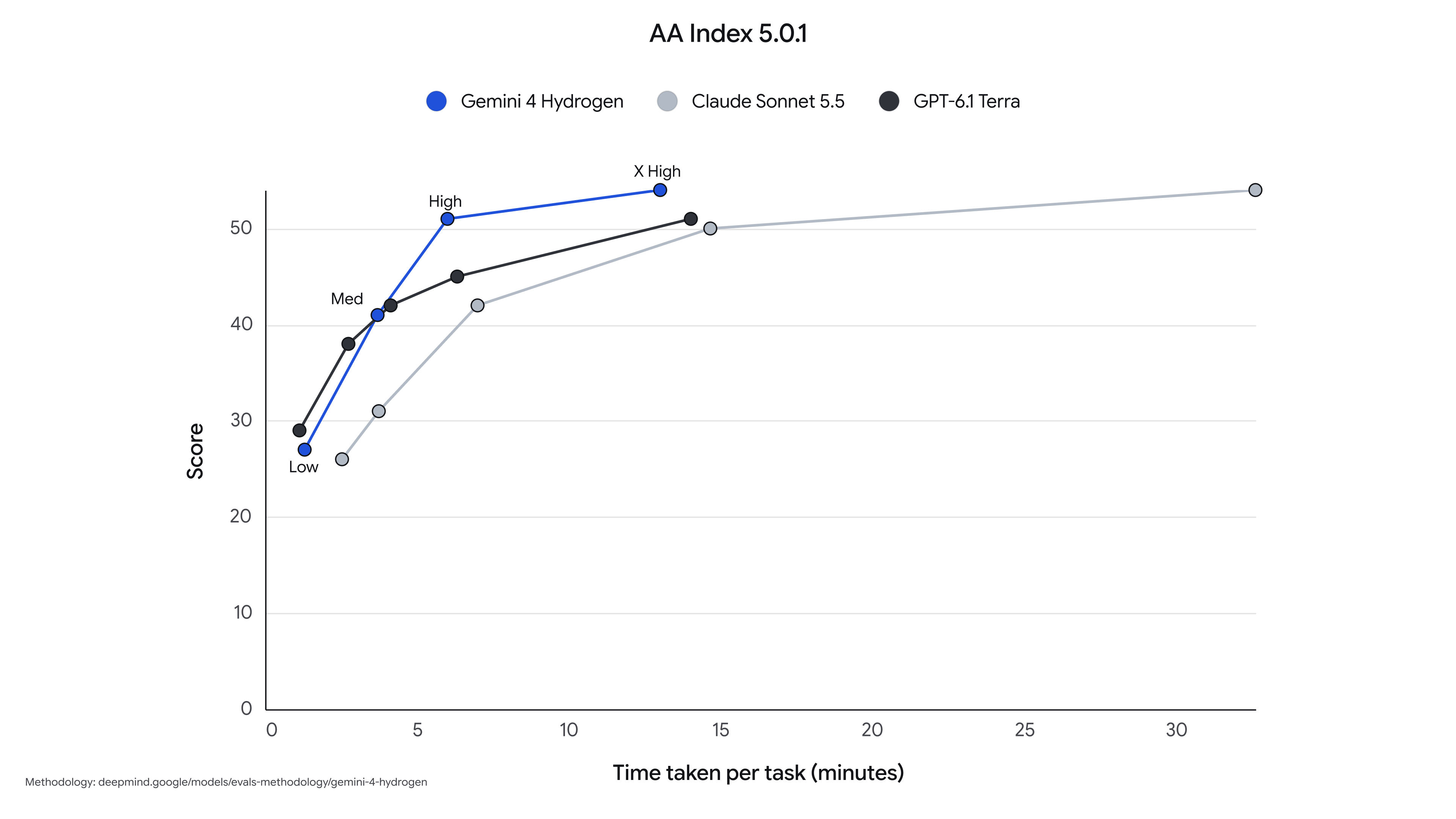
Gemini 4 Hydrogen benchmark score and completion time, as reported by Google. Source: Google.